By
By Most kids complain about stomach aches so often you just stop overthinking them. Moreover, you assume it’s a bad lunch, gas, or a passing virus.
So, you end up telling them to lie down.
However, sometimes, hours pass, and they still are not getting better.
And that’s when the worry hits. This makes you realize you have no clue if this is a minor issue or an emergency room trip.
That issue may be appendicitis.
Considering that possibility, the primary signs of appendicitis in kids include stomach pain.
That starts near the belly button and shifts to the lower right side, loss of appetite, nausea, vomiting, and a low-grade fever.
Thus, if your child has all of this happening at once, stop waiting out the clock.
Instead, spotting this specific combination early means you can drop the late-night Google panic, trust your gut, and get them to a doctor before things go sideways.
A Brief Guide To Appendicitis
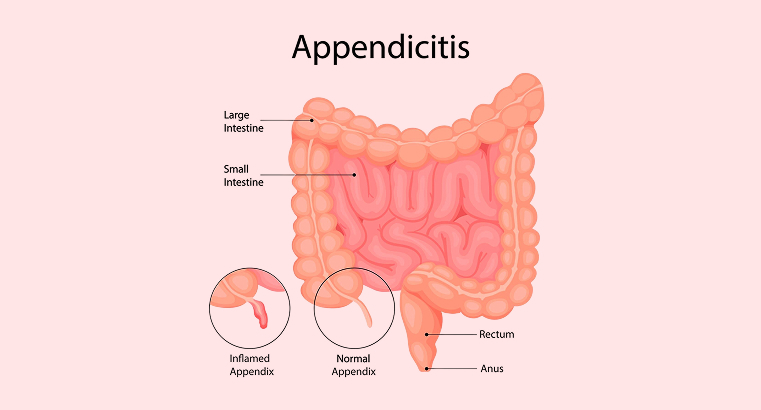
First, let us understand appendicitis.
In medical terms, appendicitis can be literally translated to “inflammed appendix”. Clinically, appendicitis is the inflammation and infection of the appendix.
The appendix is a small, finger-shaped pouch connected to the large intestine, requiring prompt medical evaluation for an infection.
Actually, appendicitis is a common abdominal emergency faced by people across all age groups, occurring due to inflammation. Following this inflammation, it starts to fill with pus.
If neglected, the condition can cause a rupture. This can have life-threatening complications.
Thus, timely diagnosis and treatment have a significant role to play here.
Stages Of Appendicitis In Kids
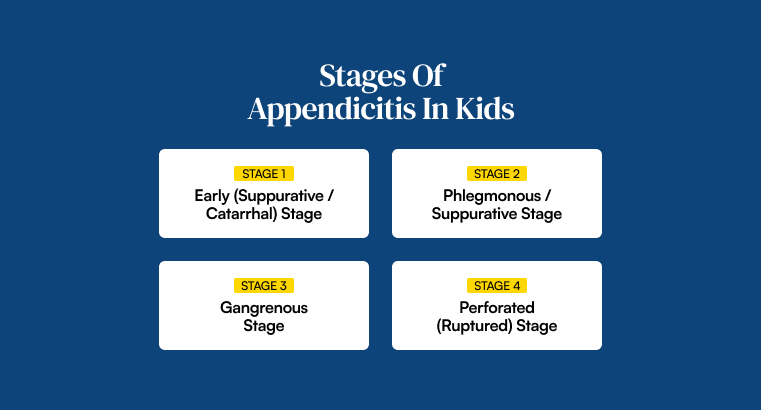
In children, appendicitis typically progresses through four distinct stages.
Furthermore, the recognition of each stage is helpful to identify warning signs before a medical emergency occurs.
| Stage & Name | Biological Mechanism | Key Symptoms |
| Stage 1: Early (Suppurative / Catarrhal) | Blocked appendix opening causes fluid and bacteria to build up, leading to mild swelling. | Dull pain around the belly button, shifting to the lower right side; low-grade fever; loss of appetite; mild nausea. |
| Stage 2: Phlegmonous (Suppurative) | Inflammation sharpens and intensifies as pus begins forming inside and along the organ walls. | Constant, sharp, highly localized lower right belly pain; worsened by coughing or walking; increased fever and vomiting. |
| Stage 3: Gangrenous | Severe swelling cuts off normal blood flow, causing tissue death and necrosis of the walls. | Severe, continuous pain; high fever; extreme abdominal tenderness; intense fatigue; immediate risk of bursting. |
| Stage 4: Perforated (Ruptured) | Appendix wall breaks, leaking bacteria and pus into the abdomen, causing peritonitis or an abscess. | Sudden widespread belly pain; high fever; rigid, swollen stomach; rapid heart rate; usually happens within 48 to 72 hours. |
Stage 1: Early (Suppurative / Catarrhal) Stage
In this stage, the opening of the appendix becomes blocked. This blockage is usually caused by stool or swelling of the lymph nodes.
As a result, this causes fluid and bacteria to build up. The inner lining becomes mildly inflamed and swollen.
One of the primary symptoms is vague and dull pain around the belly button.
Also known as periumbilical pain, this eventually shifts to the lower right side of the abdomen.
This is also accompanied by a low-grade fever, loss of appetite, and mild nausea.
Stage 2: Phlegmonous / Suppurative Stage
In the phlegmonous stage, the inflammation intensifies, and pus begins to form inside and along the walls of the appendix.
The abdominal pain in this stage becomes much sharper, constant, and more localized to the lower right side.
Any movement, coughing, or walking makes the pain significantly worse. Vomiting and fever usually increase in this stage.
Stage 3: Gangrenous Stage
The gangrenous stage is followed by swelling, where the pressure cuts off normal blood flow to the appendix wall. This is known as ischemia.
As a result, this leads to tissue death or necrosis.
Generally, symptoms such as severe, continuous pain, high fever, extreme abdominal tenderness, and severe fatigue occur in this stage.
The organ is at an immediate risk of bursting.
Stage 4: Perforated (Ruptured) Stage
The final stage is perforation of the appendix.
Here, the weakened appendix wall breaks or ruptures. As a result, this spills bacteria and infectious pus into the abdominal cavity.
Consequently, this can trigger a widespread abdominal infection known as peritonitis. Moreover, it can also cause a dangerous systemic response, sepsis.
An abscess or a localized pocket of pus may also form.
A rupture frequently happens within 48 to 72 hours of symptom onset. The following symptoms should be observed.
- Sudden worsening of pain, which may temporarily feel like it spreads across the entire belly
- high fever
- swollen or rigid abdomen
- rapid heart rate
- signs of severe illness
Common Signs And Symptoms
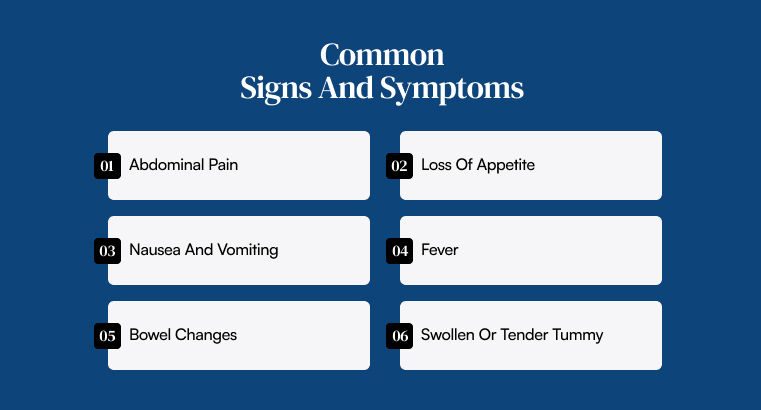
Recognizing appendicitis on an early basis means one thing definitely. You can watch how a basic stomach ache can quickly spiral into a full-body issue.
Over just a few hours, a simple bellyache turns into a dangerous mix of localized pain, digestive shutdown, and a steady fever.
Abdominal Pain
One of the most common signs you should watch out for is abdominal pain.
Typically, it starts as a dull ache right around the belly button before shifting down to the lower right side of the stomach.
Once it moves, it becomes constant and sharp, getting significantly worse if your child tries to walk, cough, or jump.
Loss Of Appetite
When a child is suffering from appendicitis, there is always an experience of a sudden and complete refusal to eat.
Moreover, they will completely turn down their favorite meals or snacks. Generally, this is a major biological sign that their digestive tract is shutting down.
Nausea And Vomiting
Feeling sick to the stomach and throwing up at frequent times follow right behind the onset of the belly pain.
In case your child’s vomiting and cannot k
Fever
An infected appendix almost always triggers a mild or low-grade fever that hovers consistently between 99°F and 101°F.
This baseline temperature rise is the body’s natural way of trying to fight off the localized inflammation.
Bowel Changes
The internal swelling can completely disrupt your child’s normal bathroom habits, causing sudden constipation or diarrhea.
If they do have loose stools, it will often consist of small amounts of watery stool mixed with visible mucus.
Swollen Or Tender Tummy
Your child’s stomach may look noticeably bloated, distended, or feel uncharacteristically firm to the touch.
The entire lower right area will be intensely sensitive. Moreover, they will likely flinch or cry out if you press on it even gently.
Age-Specific Differences
Trying to spot appendicitis becomes a lot harder when a child is too young to explain how they feel. The reason behind this is that toddlers cannot point to a specific spot on their hips.
Therefore, you have to rely completely on sudden shifts in their behavior and movement.
Younger Children And Toddlers
When it comes to younger kids, usually there is no classic lower-right belly pain. Instead, you get to see a broad and full-stomach ache.
You need to watch out for extreme crankiness, unusual lethargy, or intense fussiness, along with a swollen tummy that they fiercely guard when you try to touch it.
The “Jump Test”
For older kids who can follow directions, try to ask them to hop up and down on two feet. That will be a fast way to check the severity of the pain.
In case your child is hesitant or cries out due to the jarring impact, it hurts the lower right side of their belly. This is basically a massive red flag for appendicitis.
What To Do Immediately If Your Child Has Appendicitis?

Because appendicitis can progress rapidly into a dangerous rupture, you must treat the situation as an immediate emergency.
Thus, hesitating or trying to treat the symptoms at home can significantly worsen the infection. As a result, this causes further delay in critical medical care.
So, if you suspect your child has appendicitis, seek emergency medical evaluation or contact your pediatrician immediately.
This is further applicable if the lower-right abdominal pain is paired with vomiting and a fever.
Go straight to the nearest emergency room instead of waiting for a regular clinic appointment to open up.
In addition, do not give your child any food, water, or pain medications until a doctor evaluates them. This is because an empty stomach is required if they need immediate surgery.
On the other hand, never give them laxatives, enemas, or heating pads, as these increase intestinal pressure and can force the appendix to burst.
While you are on the way to the hospital, avoid relying on unverified internet forums or chat rooms for advice.
For accurate, step-by-step guidance on what to expect during the hospital evaluation, trust established clinical resources.
Disclaimer: The information provided in this article is for general informational purposes only. It does not, and is not intended to, constitute medical or health advice. Please consult a qualified healthcare professional for medical guidance or expert health assistance.
References
- Boston Children’s Hospital. (2026). Appendicitis. Boston Children’s Hospital.
- Zaka, H., Farwa, U. E., Ahsan, N., Broomfield, A., Akbar, A., & Khawaja, U. A. (2023). Typical and Atypical Presentations of Appendicitis and Their Implications for Diagnosis and Treatment: A Literature Review. Cureus, 15(4), e37024. National Library of Medicine.
- De, A. (2025, October 7). A complete guide to appendicitis: causes, stages and surgery explained. Sarvodaya Hospital.
What is your reaction?