
 By
One of the worst physical alarms that your body can give you is a sudden and increasing abdominal pain.
A very slight stomach ache or slight indigestion usually gets better on its own.
A severe, persistent lower right abdominal pain, however, should be treated immediately.
The initial diagnostic goal in an emergency department with a patient with acute abdominal pain is frequently to assess the integrity of the appendix.
If you want to get an idea of how this medical emergency is progressing, you need to look at the 4 stages of appendicitis.
Appendicitis is not a disease of a moment. Instead, it is a disease that evolves over time.
Rather, it’s a quick, time-sensitive inflammatory pathway that goes from a simple, uncomplicated blockage to a life-threatening, complicated rupture in hours.
This all-in-one resource will:
- Explain the anatomical causes of appendicitis
- Describe the clear pathological process in each of the four stages
- Explain the difference between complicated and uncomplicated cases
- Plan your current treatment options to keep you healthy.
Appendicitis: Breaking Down The Condition
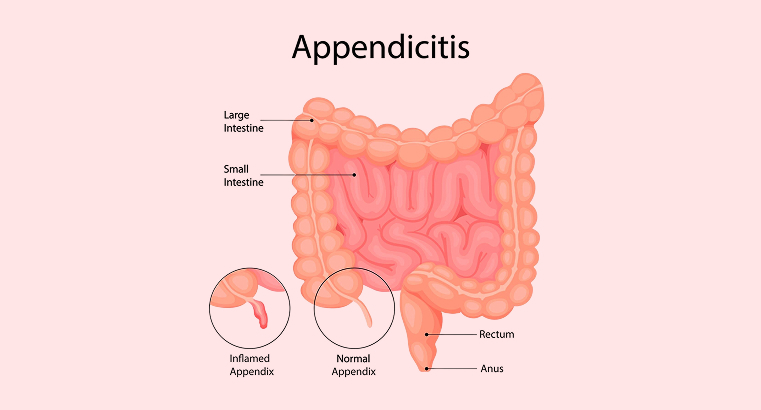
It is helpful to first have an understanding of the normal anatomy and the mechanical factors that initiate the disease process.
Location Of Appendix
So, before we get into what the appendix is, let’s first understand what it is.
The appendix is a small, thin, finger-like pouch attached to the cecum, the initial part of the colon.
Furthermore, it is located in the lower right quadrant of your abdomen, around a clinical landmark known as McBurney’s point.
The appendix has been known as a vestigial organ for a long time, but recent clinical studies suggest it could serve as a secure storage vault for useful gut bacteria.
In addition, it plays a subtle role in your body’s immune surveillance system.
Causes
A direct is the main biological cause of appendicitis. Mechanical blockage of the lumen of the appendix. This is actually the cavity of the pouch.
There are several different reasons for this internal blockage.
- Hard, calcified stool lumps (fecaliths) that get stuck in the opening.
- Swollen sheets of lymphoid tissue in the wall of the appendix (lymphoid hyperplasia)
- Objects or tumors in the body that are not supposed to be there.
The 4 Stages Of Appendicitis
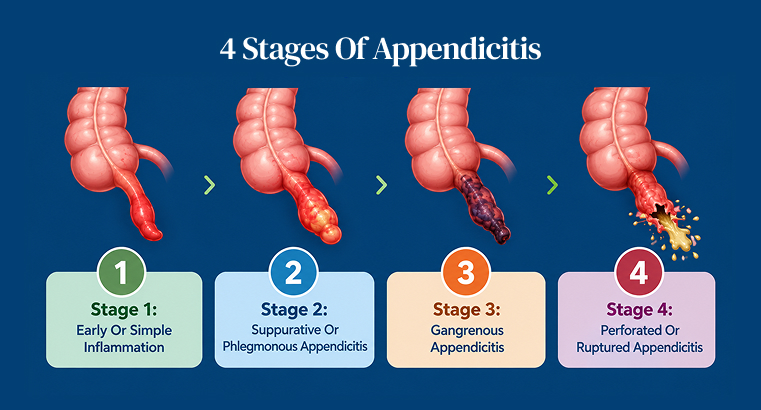
When the inside chamber is fully closed, the mucus and fluids keep accumulating in the closed space.
This forms an environment for bacteria to grow and begins a four-step process of structural deterioration of the tissue walls.
Stage 1: Early Or Simple Inflammation
The first stage starts as soon as the lumen becomes obstructed.
The natural secretions of the appendix are unable to drain, causing the pressure to build up inside.
This pressure causes the local blood vessels to be compressed and the outer walls of the organ to be stretched, causing slight tissue swelling (edema).
Symptom Presentation
In this uncomplicated stage, the pain is usually dull, vague and diffuse.
The initial stage starts at the exact moment something blocks the lumen.
First, the visceral nerve pathways activate. As a result, patients typically experience constant pain around the belly button.
This is often accompanied by a loss of appetite and slight nausea.
Stage 2: Suppurative Or Phlegmonous Appendicitis
When the blockage is present for 12 to 24 hours, bacteria grow rapidly within the fluid.
Your immune system reacts by sending white blood cells to the area. This leads to the formation of a thick and purulent fluid (pus).
Furthermore, the appendix becomes very large, and the inflammation spreads outward to irritate the abdominal lining.
Anatomy experts call it the parietal peritoneum.
Symptom Presentation
This structural change results in dramatic changes in the behaviour of the pain.
The dull ache in the navel area suddenly moves and becomes sharp. This causes direct locking in the lower right quadrant of the abdomen.
The pain worsens greatly when the patient coughs, walks, or when an examiner touches the abdomen (rebound tenderness).
Stage 3: Gangrenous Appendicitis
When the internal pressure inside the swollen organ completely surpasses the pressure of the incoming bloodstream, the local arteries collapse.
Ischemia deprives tissue cells of oxygen and nutrients, causing them to die.
This necrosis of the tissue soon turns into gangrene. As a result, it makes the physical walls of the appendix structurally weak, dark, and very weak.
Symptom Presentation
The physical distress of the patient reaches an extreme peak during this stage.
An exceptionally high fever, chills, persistent vomiting, and a rapid heart rate (tachycardia) characterize the symptoms.
The abdominal muscles over the lower right quadrant often become completely rigid and hard to the touch. Involuntary guarding is a defensive response.
Stage 4: Perforated Or Ruptured Appendicitis
This is the final, most dangerous phase of the inflammatory pathway.
Additionally, the condition typically manifests if you leave it unmanaged past the 48-to-72-hour mark.
The fragile, gangrenous walls can no longer hold back the intense internal pressure, causing the tissue to tear open.
This perforation releases highly infectious pus, fecal material, and bacteria straight out into the open abdominal cavity.
Symptom Presentation
A highly dangerous diagnostic pitfall can occur the exact second the appendix ruptures.
Since the intense internal pressure is suddenly released, the patient may experience a brief, misleading wave of physical relief.
Here, we assume that the crisis has passed.
However, within hours, the spilled infectious material triggers a massive, life-threatening abdominal infection called peritonitis.
Because the internal pressure suddenly releases, the patient may experience a brief, misleading wave of physical relief.
Distinguishing Between The Uncomplicated And Complicated Stages
Medical researchers divide appendicitis cases into two distinct structural classifications to help surgical teams determine how quickly to operate.
This is on the basis of whether the infection has spread beyond the organ wall.
| Pathological Classification | Associated Stages | Structural Condition of the Appendix | Primary Treatment Goal |
| Uncomplicated Appendicitis | Stage 1 & Stage 2 | The organ is inflamed and swollen, but the tissue walls remain fully intact and closed. | Perform a clean, controlled removal before the tissue boundaries break down. |
| Complicated Appendicitis | Stage 3 & Stage 4 | The tissue is actively dying (gangrene), or has split open, leaking pus and fecal waste into the abdomen. | Emergency surgery paired with extensive abdominal washing and high-dose IV antibiotics. |
Treatment Strategies

Once high-resolution diagnostic imaging confirms the diagnosis, the medical team will immediately implement a targeted treatment pipeline.
For instance, an abdominal ultrasound or a CT scan.
Surgical Intervention: Appendectomy
The definitive global standard of care for acute appendicitis is the surgical removal of the organ. Doctors call this an appendectomy..
The choice of surgical approach is dependent on the severity and stage of the infection.
| Surgical Approach | When It Is Used | Operational Procedure | Recovery & Benefits |
| Laparoscopic Appendectomy | Used primarily in uncomplicated cases (Stages 1 & 2). | Keyhole surgery using tiny abdominal incisions to insert a camera and miniature tools. | Offers a significantly faster recovery time and a lower risk of post-operative complications. |
| Open Appendectomy | Mandatory for complicated cases (Stages 3 & 4 with perforation). | A single, larger incision is made in the lower right quadrant of the abdomen. | Allows the surgical team to thoroughly wash out leaked infectious fluids, preventing peritonitis. |
Antibiotic Protocols
Intravenous antibiotics are a core component of the treatment protocol.
In specific, highly selected cases of early, uncomplicated appendicitis, some clinical centers may attempt a purely conservative, antibiotic-only treatment model.
However, because this path carries a notable risk of recurrence within the first year, surgery remains the primary recommendation for the vast majority of cases.
This helps to permanently eliminate the risk of a future rupture.
Consult A Healthcare Professional Immediately
In conclusion, trying to analyze the 4 stages of appendicitis proves one thing.
A sharp, migrating abdominal ache causes a fast-moving physical emergency that you cannot safely manage with home remedies or a “wait and see” attitude.
The appendix relies on rapid, early clinical identification before its structural walls degrade from a simple inflammation into a dangerous tissue rupture.
If you or a loved one are experiencing the following:
- persistent lower right abdominal pain paired with a fever
- Nausea
- rebound tenderness
Do not wait for the symptoms to temporarily disappear.
Instead, contact a medical professional immediately or head straight to the nearest emergency department.
Taking swift, decisive action allows your medical team to step in early. Moreover, it will permanently resolve the infection.
In this way, it protects your vital organs while securing your long-term health.
Disclaimer: The information provided in this article is for general informational purposes only. It does not, and is not intended to, constitute medical or health advice. Please consult a qualified healthcare professional for medical guidance or expert health assistance.
References
- Khanna, J. (2026). Appendicitis: Types, stages, causes, and treatment. Max Healthcare.
- Mayo Clinic. (2025). Appendicitis – Diagnosis and treatment. Mayo Clinic.
- National Institute of Diabetes and Digestive and Kidney Diseases. (2025). Treatment for appendicitis. National Institute of Diabetes and Digestive and Kidney Diseases.
What is your reaction?