By
We all have to work. And earning a living is an inevitable part of our lives. However, while daily hustle is unavoidable, spending at least eight hours (and sometimes more than that) completely glued to a chair should not be the case.
The thing is, modern desk jobs keep us chained to our screens longer than ever before, forcing us to sacrifice our physical health just to clear our daily task lists.
When you are constantly sitting still, it leads to poor posture, saps your daily energy, and seriously damages your long-term health. Hard work should not require you to sacrifice your physical well-being.
So, in order to survive the grind without burning out, you need to actively break up your sedentary routine and get your blood flowing again.
Fortunately, making a meaningful choice does not require you to spend hours at the gym. By intentionally incorporating the best exercises during work breaks, you can easily protect your body and boost your focus. Besides, you can reclaim your energy right from the office.
Let us take a look at the harsh reality of our current workspace habits before diving into how you can easily fix them.
| Did You Know? |
| • Indian white-collar work hours are among the highest measured anywhere in the world (RK, 2026). • Managers work 57.2 hours a week, whereas professionals work 51.6. But American figures state 41.3 and 38.1 hours, respectively, and Germany shows 40.4 and 33.8 hours, respectively. • Working hard ≠ Thriving. In fact, workplace engagement in India has experienced a sharp decline over the last three years, falling from 33% to 23%, while a mere 17% of professionals report finding true fulfillment in their roles. • Nearly half of the workforce in India already exceeds the International Labour Organization’s threshold for excessive labor, with 48.8% of employees working 49 or more hours per week. • In stark contrast, this figure drops to just 11.3% in the United States, 8.5% in the United Kingdom, and 4.2% in Germany. |
The Curse Of The Sedentary Lifestyle: Is Sitting The New Smoking?
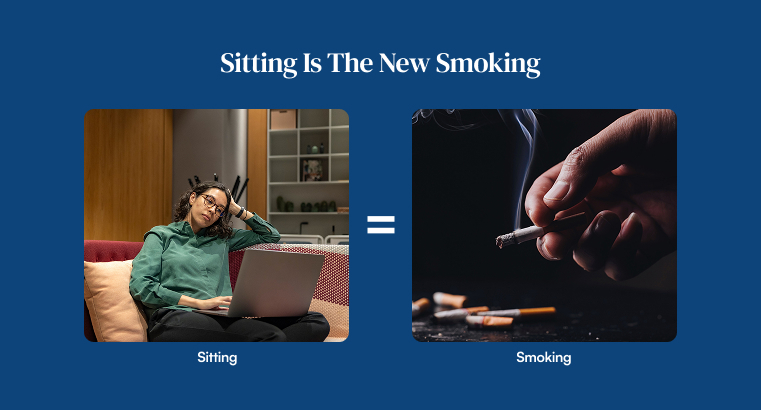
So, what exactly is a sedentary lifestyle?
To explain it clearly, a sedentary lifestyle is a type of daily routine where a person spends most of their waking hours sitting, reclining, or lying down with very little physical movement or exercise.
Typically, this involves an energy expenditure of 1.5 metabolic equivalents or less.
According to Siddiqi et al. (2025), with the rise of remote work models, especially post-pandemic, there has been a notable increase in sedentary behavior among professionals. Moreover, prolonged sitting is increasingly recognized as an independent risk factor for cardiovascular disease. This has given rise to the phrase “sitting is the new smoking.”
Factually, prolonged sitting is not literally worse than smoking. However, public health campaigns are now using this phrase to highlight the serious dangers of living a sedentary lifestyle.
According to various studies that analyze large populations show that sitting for more than 8 hours a day with zero physical activity can elevate your risk of heart disease. Additionally, it is said to cause early death to a level comparable to the risks associated with smoking or obesity.
Now, let us understand the biological mechanism. When you sit for hours, your blood circulation slows, your metabolism drops, and your body’s ability to process insulin and fats becomes impaired.
As a result, this increases your risk of type diabetes, heart disease, high blood pressure, and certain cancers.
At A Glance: How Prolonged Sitting Harms Your Body
| Affected Area | Immediate Biological Effect | Long-Term Health Risk |
| Metabolism | Shuts down fat-burning enzymes and slows insulin response | Type 2 diabetes and metabolic syndrome |
| Heart & Circulation | Pools blood in lower limbs and slows overall blood flow | High blood pressure, varicose veins, Deep Vein Thrombosis (DVT), Pulmonary Embolism (PE), and heart attacks |
| Muscles & Bones | Weakens the core and glutes while tightening hip flexors | Chronic back pain, neck stiffness, and poor posture |
| Brain & Mind | Reduces oxygen delivery to the brain and drops hormone levels | Brain fog, low productivity, anxiety, and depression |
| Lifespan | Causes systemic decline across multiple bodily functions | Significantly higher risk of early death from all causes |
Metabolic Slowdown
When you remain seated for long stretches, your body essentially goes to sleep at a cellular level. Moreover, your muscles stop contracting, which causes the production of lipase to drop drastically. Lipase is an enzyme that is essential for breaking down fats.
At the same time, the overall ability of your body to process glucose plummets because your muscles become less responsive to insulin. This combination causes blood sugar levels to spike and fatty acids to build up in your bloodstream, paving the way for type 2 diabetes and metabolic syndrome.
Cardiovascular Strain
When you sit still, it forces your heart to work harder to pump blood against gravity. Since leg muscles are inactive, they stop helping to push blood back up to your heart. As a result, this leads to circulation becoming sluggish.
This pooling of blood in your lower limbs can cause the veins to stretch and weaken. As a result, this leads to painful varicose veins. Far more dangerously, this stagnation can cause blood clots to form in your deep leg veins. This condition is known as Deep Vein Thrombosis (DVT).
If a piece of that clot breaks free and travels to your lungs, it can lead to a life-threatening Pulmonary Embolism (PE). Over time, this constant circulatory stagnation also drives up your blood pressure, allowing plaque to build up in your arteries.
This significantly increases your risk of heart attacks.
Musculoskeletal Decay
Your body operates on a “use it or lose it” principle, and prolonged sitting actively dismantles your posture.
When you slouch over a desk, your hip flexors tighten and shorten, while your glutes and core muscles completely switch off. This muscular imbalance forces your lower back and neck to bear the entire weight of your upper body, leading to chronic spinal misalignment.
Over months and years, this decay results in persistent back pain, herniated discs, and stiff joints.
Cognitive And Mental Decline
The physical stagnation of sitting has a direct impact on the way your brain functions. Sluggish blood circulation reduces the amount of fresh oxygen as well as vital nutrients reaching your brain tissue.
With this lack of fuel, ultimately you feel something known as brain fog, which is followed by decreased problem-solving skills along with a noticeable drop in daily productivity.
In addition, a lack of physical movement alters your brain chemistry, slowing down the production of endorphins and serotonin. So, directly, you have an increase in being vulnerable to stress, anxiety and depression.
Increased Mortality Risk
The cumulative damage of metabolic, cardiovascular, and structural decline creates a dangerous recipe for your overall lifespan. So when these bodily systems are consistently under-stimulated, your body tends to lose its resilience against chronic diseases.
According to an article by Times of India (2025), sitting for prolonged periods can increase the risk of cardiovascular mortality. In fact, large-scale population studies have claimed that the damage caused by sitting for over eight hours a day cannot easily be undone by a quick workout later.
This systemic breakdown quietly shortens your life. As a result, this causes a significantly higher risk of premature death from all causes.
What Does The Statistics Say: Just How Sedentary Are We?
Now, let us take a deep look at the statistics and data.
As per research, Indian white-collar professionals are trapped in an incredibly sedentary, overextended lifestyle. According to the Indian Employee Productivity Report 2026, Indian managers clock a massive 57.2 hours of work per week. On the other hand, general professionals log 51.6 hours of work.
This excessive desk time leaves the Indian workforce far more stationary than their global peers.
In fact, 48.8% of the Indian workforce pushes past the International Labour Organization’s threshold for excessive work by logging over 49 hours per week.
This completely overshadows countries such as the United States, where only 11.3% of workers hit those numbers, and Germany, where a tiny 4.2% cross that line.
To make matters worse, Indian knowledge workers report an average daily round-trip commute of 93 minutes. Now, add massive chunks of stationary time to an already exhausting day.
For example, Bengaluru leads this local gridlock, forcing commuters to lose 168 hours to rush-hour delays annually.
This toxic combination of extreme office hours and grueling commutes creates a dangerous routine. Here, professionals sit still for nearly their entire waking day.
Global Comparison Of Weekly Work Hours And Workplace Strain
| Country Profile | Weekly Manager Work Hours | Population Working 49+ Hours Weekly | Average Daily Commute Time |
| India | 57.2 Hours | 48.8% | 93 Minutes |
| United States | 41.3 Hours | 11.3% | 48 Minutes |
| Germany | 40.4 Hours | 4.2% | 64 Minutes (Global Avg) |
What Is The “Active Couch Potato” Trap?

So, in the active couch potato, you are basically stuck in a situation where you exercise regularly but still go on to face the severe health risks of a sedentary lifestyle.
A large number of people tend to assume that hitting the gym for thirty to sixty minutes a day completely shields them from the dangers of desk work. Unfortunately, clinical evidence shows otherwise.
An hour dedicated to intense exercise cannot reverse the biological damage that sitting straight for eight to ten hours causes.
Going for a run after work is great for your heart, but it does not undo the hours of stagnation that came before it. True health requires you to actively disrupt your sitting time throughout the day rather than relying on a single, isolated workout.
| Behavioral Profile | Typical Daily Activity | Impact on Long-Term Health Risks |
| Traditional Couch Potato | Sits all day at work and watches television all evening without exercising | High risk for cardiovascular disease, metabolic syndrome, and early mortality |
| Active Couch Potato | Sits for eight hours at a desk but exercises for forty-five minutes daily | Still carries elevated risks for heart strain, sluggish circulation, and diabetes |
| Activity-Breaker Profile | Interrupts office sitting every thirty minutes with brief, active movements | Significantly lowers metabolic risks, improves insulin response, and protects posture |
What Cardiologist Dr. Saket Goyal Recommends To Do While At Your Desk
So, how do you break this curse of being an active couch potato stuck in a sedentary lifestyle?
Dr. Saket Goyal has some tips for you! In episode 171 of his series named “Dil Dhadakne Do” the cardiologist goes on to recommend a few things.
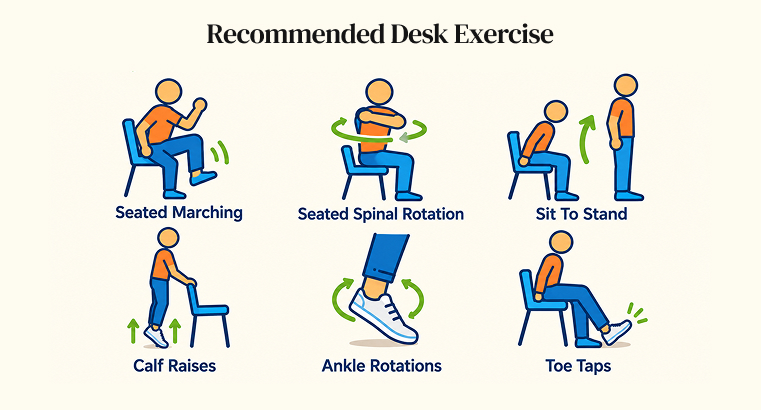
First of all, he suggests staying active and countering the health risks of prolonged sitting. This can be done by performing a 5-exercise office chair routine at least twice during an 8-hour workday.
In this episode, he went on to say how you can just take a 2-minute movement break every hour after say 58 minutes of just sitting. In this way, you will be able to protect your overall heart health.
Recommended Desk Exercises
According to Dr. Goyal, these five simple desk movements on his social media pages can help you break up sedentary office hours.
| Recommended Desk Exercise | Proper Execution Method | Primary Physical Benefit |
| Seated Marching | Sit straight up and pump your knees toward your chest alternatively | Activates the core and wakes up tight hip flexors |
| Seated Spinal Rotation | Twist your upper torso safely to one side while gripping your chair armrest | Relieves built-up lower back tension and spinal stiffness |
| Sit To Stand | Stand all the way up from your office chair without using your hands | Engages your leg muscles and boosts immediate circulation |
| Calf Raises | Lift your heels high while keeping your toes firmly planted on the ground | Pumps pooled blood from lower limbs back up to the heart |
| Ankle Rotations And Toe Taps | Roll your ankles in circles and tap your toes quickly against the floor | Reduces ankle swelling and fights off blood clot risks |
Additional Workday Movement Tips
Beyond the chair routine, incorporating these daily baseline habits will maximise your circulatory health.
| Movement Strategy | Practical Workplace Implementation | Expected Health Outcome |
| Take 2-Minute Micro-Breaks | Set a repeating phone timer to ring every fifty-eight minutes as a movement prompt. | Prevents your body from dropping into a deep hibernation state. |
| Use the 3-Slot Walk Hack | Commit to a brief ten-minute walk after your morning tea, lunch break, and evening tea. | Breaks your massive sitting block into manageable intervals. |
| Try Isometric Wall Sits | Lean your back flat against an office wall and slide down into a static squat for thirty seconds. | Builds lower body endurance and spikes your cellular metabolism. |
But Don’t Let Your Break Go To Waste! Here Are The Best Exercises During Work Breaks
Remember one thing! Your break time is a massive opportunity for you to break the curse of living a sedentary lifestyle.
Stepping outside for a few minutes of fresh air is the ultimate opportunity to reverse the physical damage of desk work. However, you should never let these precious moments go to waste.
So, do not just simply stand around on the pavement while staring at your phone screen. To actually reset your system, you need to actively use this time to get your heart rate up.
In this way, you can lubricate your stiff joints and flush fresh oxygen through your bloodstream.
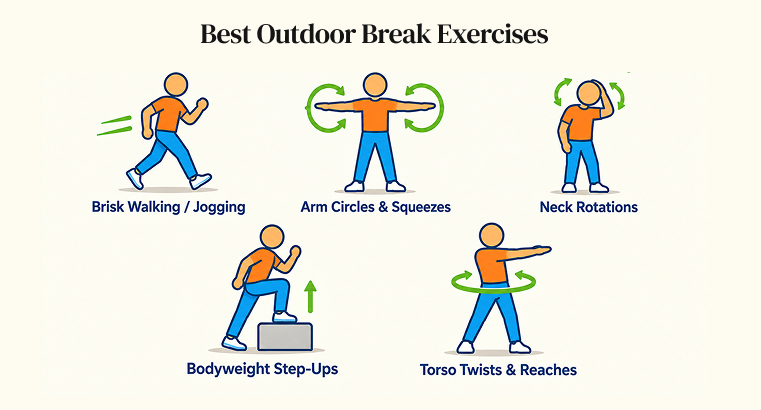
Best Outdoor Break Exercises
Here is a comprehensive list of exercises you can follow.
| Exercise Choice | Proper Focus | Core Physical Result |
| Brisk Walking / Jogging | Fast, rhythmic pace | Spikes your cardiovascular health |
| Arm Circles & Squeezes | Open chest movement | Corrects desk-bound shoulder hunching |
| Neck Rotations | Slow, deliberate circles | Relieves severe typing tension |
| Bodyweight Step-Ups | Controlled leg power | Strengthens knees and activates glutes |
| Torso Twists & Reaches | Full side stretching | Unlocks a stiff, compressed spine |
Brisk Walking Or Light Jogging
Instead of a casual stroll, step up your pace into a purposeful power walk. On the other hand, you may also have a light jog around your office building perimeter.
In this way, you can instantly boost your circulation and clear out accumulated mental fatigue.
Arm Circles And Shoulder Squeezes
To do this, extend your arms straight out to your sides and make slow circles. Afterward, pull your elbows back forcefully to pinch your shoulder blades together. This will actively force your body out of the hunched posture that is caused by typing.
Neck Rotations
Drop your chin completely down to your chest and slowly roll your head in a full circle before reversing directions, allowing the weight of your head to release the tight muscles at the base of your skull.
Bodyweight Step-Ups
Locate a secure outdoor staircase step or a sturdy concrete ledge and alternate stepping up and down, which wakes up your sleeping glutes and forces your lower body to engage.
Torso Twists And Side-To-Side Reaches
Stand with your feet wide while twisting your upper body from left to right. Afterward, reach one arm high over your head to lean on the side. Go on to safely stretch out your tight lower spine and obliques.
Break The Curse And Take Charge Of Your Health: You Can Do This!
In order to maximize your brief moments in the fresh air, you must change how you treat your break time.
First, leave your smartphone completely out of sight at your desk. The reason behind this is that staring at a smaller screen while walking would just defeat the purpose of a mental reset.
Second, try to step directly into natural sunlight for at least ten minutes during your outdoor loop to trigger a healthy dose of Vitamin D. This helps in the regulation of your sleep cycle while boosting your mood.
Lastly, always drink a full glass of water right before you head outside and immediately when you return. That way, you get to keep your joints properly lubricated and assist your body in flushing out metabolic waste.
Disclaimer: The information provided in this article is for general informational purposes only. It does not, and is not intended to, constitute medical or health advice. Please consult a qualified healthcare professional for medical guidance or expert health assistance.
References
- TOI Lifestyle Desk. (2025, December 7). Sitting 8 hours a day? Even exercise can’t undo the damage; these habits might. The Times of India.
- Sitting risks: How harmful is too much sitting? (2025, March 26). Mayo Clinic.
- Department of Health & Human Services. (n.d.). The dangers of sitting: why sitting is the new smoking. Better Health Channel.
- Park, J. H., Moon, J. H., Kim, H. J., Kong, M. H., & Oh, Y. H. (2020). Sedentary Lifestyle: Overview of updated evidence of potential health risks. Korean Journal of Family Medicine, 41(6), 365–373. PubMed Central.
- Rk, A. (2026, October 22). India Employee Productivity Report 2026: Key Data | Hyring. Hyring.
- Haidar, F. (2025, September 16). Indian workers clock 52% of weekly hours in office, below global average. The Economic Times.
- Cleveland Clinic. (2025, May 16). What a sedentary lifestyle can do to your health. Cleveland Clinic.
- Siddiqi, M. M., Sufian, A., Farhan, A. A., & Siddiqi, M.M. (2025). Sitting is the New Smoking”: Studying the Impact of Prolonged Sedentary Behavior Among Work-from-Home Professionals on Cardiovascular Health. European Journal of Cardiovascular Medicine.
What is your reaction?