
 By
Have you lost your mucus plug and are wondering what steps to follow afterwards?
First of all, of course, try to stay calm. This is common, and it does not mean labor starts today.
The plug is a thick seal that blocks your cervix during pregnancy, and it can come out days or even weeks before delivery.
However, a few habits are best avoided once it is gone.
Thus, this guide will cover the main things to avoid after losing your mucus plug, why they matter, and when to call your doctor.
Key Takeaways

• Losing your mucus plug is normal and does not always mean that labor is near
• Avoid sex, tampons, douching, and long baths unless your doctor says they are safe
• Do not pull at the plug or check your own cervix
• Skip heavy workouts and save your energy
• Call right away for bleeding, leaking fluid, or regular contractions, or if you are before 37 weeks
What Does Losing Your Mucus Plug Mean?
The mucus plug sits inside your cervix and keeps bacteria away from the womb.
When the cervix starts to soften and thin, the plug loosens and slips out. This looks like a thick, jelly-like blob that can be clear, white, pink, or slightly brown.
Some people lose it in one piece. On the other hand, some notice it in small bits over several days.
Does It Mean Labor Is Close?
To answer that in short, it is not always.
Labor can begin within hours, but can also be two weeks away. In other words, the plug signifies a sign in your body that it is getting ready and not a starting gun.
Moreover, the plug can even regrow. Thus, losing it more than once is possible.
Mucus Plug Vs. Bloody Show
People usually mix up the plug and the bloody show. Here is how you can tell them apart.
| Feature | Mucus plug | Bloody Show |
| Texture | Thick, jelly-like | Mucus streaked with blood |
| Color | Clear, white, pink or brown | Pink or red |
| Timing | Days or weeks before labor | Usually hours or days before labor |
Things To Avoid After Losing Mucus Plug
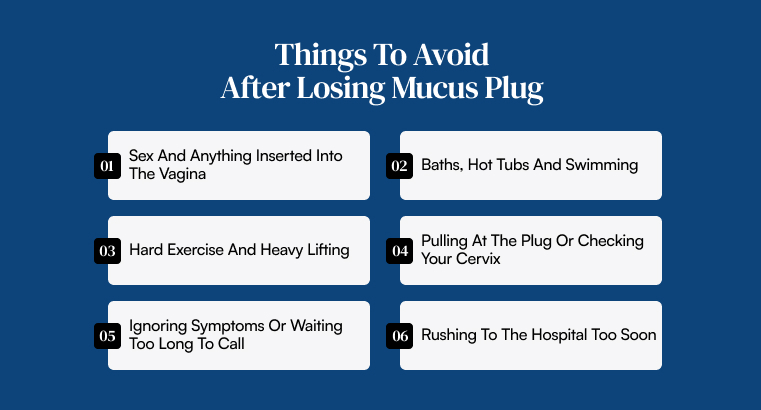
Once the plug is out, your cervix has lost some of its natural protection.
Because of that, the goal is simple. Keep bacteria out while avoiding anything that pushes your body into labor too early.
Your doctor may give you different advice if you have a high-risk pregnancy. Otherwise, these are the main things to avoid.
Sex And Anything Inserted Into The Vagina
Sex, tampons, menstrual cups, and douching can all introduce bacteria. Without the plug, germs can travel more easily toward the womb.
Therefore, many providers advise skipping them, especially if your water has broken or you have bleeding.
So, ask your doctor what applies to you.
Baths, Hot Tubs And Swimming
Showers are fine. However, baths, hot tubs, and pools are less clear.
If your membranes are intact, a quick bath usually does no harm. But many medical professionals still give suggestions to avoid long soaks.
Moreover, if your water has broken, try to avoid them completely.
Also, ask your provider and shower in the meantime.
Hard Exercise And Heavy Lifting
When it comes to gentle walking, it is permissible and even recommended to help you stay comfortable.
However, intense workouts, heavy lifting, and long periods on your feet can tire you out before labor can begin. This energy is very crucial, as you will need it soon.
Instead, rest when you can and save your strength.
Pulling At The Plug Or Checking Your Cervix
If part of the plug is still hanging out, leave it alone. Pulling on it or checking your own cervix with your fingers can bring in bacteria and cause irritation.
Let your body release it naturally, while letting your provider do any cervical checks.
Ignoring Symptoms Or Waiting Too Long To Call
Losing the plug alone is not an emergency. Yet, it is a good moment to stay alert.
Do not brush off bleeding, leaking fluid, or regular contractions. If you are before 37 weeks, call your provider the same day.
That is because losing the plug early can be a sign of preterm labor.
Rushing To The Hospital Too Soon
Many first-time parents rush in the moment they see the plug. In most cases, you can wait at home until the contractions are regular, about five minutes apart.
In addition, they last a minute to an hour. For this, follow the 5-1-1 rule.
However, follow your own provider’s advice, as it may differ.
Quick Guide: Avoid This And Do This Instead
Below, here is everything in one place. Use this guide as a quick reference when you feel unsure.
Note that it does not replace advice from your own doctor or midwife.
| Avoid | Why | Do Instead |
| Sex, tampons, douching | Can introduce bacteria | Ask your provider what is safe |
| Long baths and hot tubs | Possible infection and overheating | Take a warm shower |
| Heavy workouts | Drains your energy | Walk gently and rest |
| Pulling at the plug | Irritation and infection risk | Let it pass naturally |
| Waiting to call | Might miss early labor or complications | Call if your symptoms change |
Warning Signs After Losing Your Mucus Plug
Most of the time, losing your mucus plug is harmless. Nevertheless, some symptoms require quick medical attention. Watch for the signs below, and call your provider or go to the hospital in case you notice any of them.
Finally, trust your instincts. This is because you know your body best.
| Symptom | What it may mean | What to do |
| Bright red bleeding, like a period | Placental problem or other complication | Go to the hospital now |
| Clear fluid that keeps leaking | Broken water | Call your provider right away |
| Green or brown fluid | Baby passed meconium | Go to the hospital |
| Regular, painful contractions | Labor | Time them and call |
| Fever or foul-smelling discharge | infection | Call your provider |
| Less baby movement | Possible distress | Call immediately |
How Long Until Labor Starts After Losing Your Mucus Plug?

Here, there is no fixed timeline. Some people go into labor within 24 hours. On the other hand, others wait a week or two, or even longer.
Other signs, such as regular contractions or your water breaking, are better clues that labor has started. For that reason, avoid counting days.
In case you lose the plug before a term of 37 weeks, the whole picture changes. In addition, your baby may not be ready to arrive yet.
Thus, contact your provider in a prompt way. They may want to check your cervix and monitor you for signs of preterm labor.
What You Can Do Instead
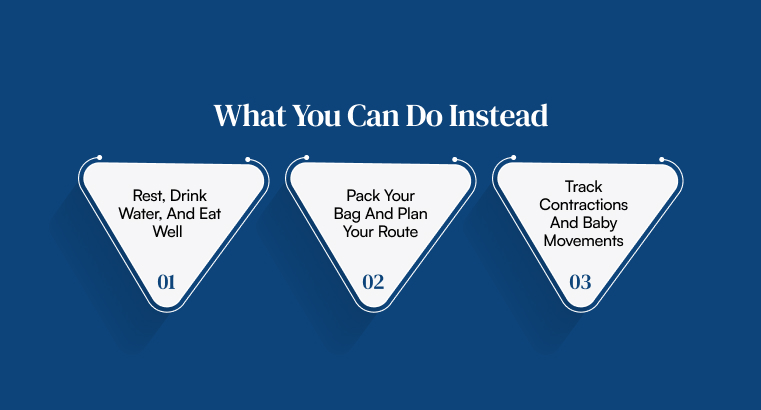
Knowing what to avoid is only half the picture. The other half is using this time well.
Since labor could start soon or in a few weeks, a little preparation now will make things calmer later.
Rest, Drink Water, And Eat Well
Sleep when you can. That is because broken nights are common near the end.
Drink plenty of water while eating small and regular meals. Good fuel now helps you cope with labor later.
Pack Your Bag And Plan Your Route
Finish packing your hospital bag, and keep your ID, insurance papers, and birth plan in one place. Also check your route to the hospital and decide who will drive you.
As a result, you will not be scrambling when contractions begin.
Track Contractions And Baby Movements
On a final note, use a simple app or a notebook to note when contractions start, how long they last, and how far apart they are.
Also, try to count your baby’s kicks daily. A sudden drop in movement is worth a call, no matter the time of day.
Disclaimer: The information provided in this article is for general informational purposes only. It does not, and is not intended to, constitute medical or health advice. Please consult a qualified healthcare professional for medical guidance or expert health assistance.
References
- American Pregnancy Association. (2026). Mucus Plug – An important Part of Pregnancy. American Pregnancy Association.
- Cleveland Clinic. (2026). Mucus Plug. Cleveland Clinic.
- Restivo, J. (2024). What is a mucus plug? Harvard Health.
- Gala, K. (2026). Mucus Plug : What is It, Looks Like And Means. Narayana Health.
What is your reaction?