By
Ever had that burning crawl up the chest, which usually arrives at the worst moments?
It may be after a late dinner, in the middle of the night, or even halfway through a meeting.
So, when that happens, the kitchen is usually the first place people tend to look. So, if you are wondering what to drink for heartburn relief, the honest answer is that a few simple drinks can calm symptoms.
On the other hand, a few popular “remedies” make things worse.
Thus, the following guide will explain why heartburn even happens, which home remedy drinks have real support behind them, which ones to skip, and when a burning chest requires a consultation with a doctor.
What Is Happening When You Get Heartburn
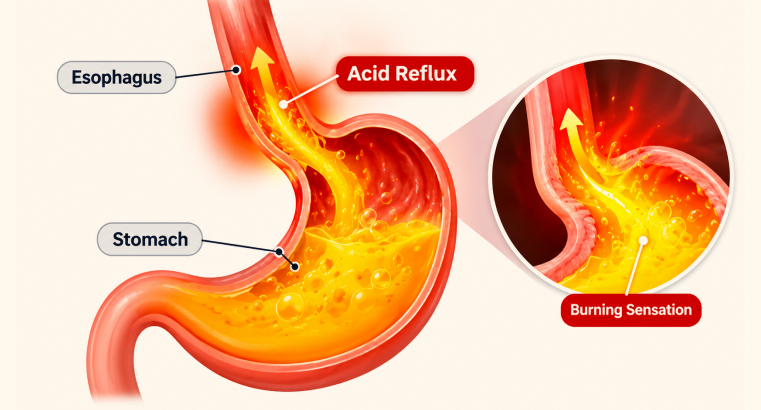
First, let us understand in detail what heartburn even is.
This is known as the burning feeling behind the breastbone that occurs when the stomach acid flows back into the esophageal sphincter (LES).
Normally, it closes after food passes through, and when it relaxes at the wrong time, acid tends to escape upward.
The lining of the esophagus has little protection against acid.
So even a small amount tends to burn. When you understand this, then you would understand why drinks matter, both the ones that help and the ones that cause harm.
Why A Drink Can Help
Usually, a drink can help you in three ways.
That is, it can:
- Dilute or wash acid back down into the stomach
- Neutralize some of the acid
- Coat and soothe the irritated lining
At A Glance
| Relief Mechanism | Action Provided | Example Drinks / Ingredients |
| Dilute & Wash | Flushes acid back down into the stomach and dilutes it. | Water |
| Neutralise | Attempts to balance and lower the acidity levels. | Alkaline drinks |
| Coat & Soothe | Creates a protective layer over the irritated throat and esophageal lining. | Aloe vera juice, slippery elm |
Why Some Drinks Make It Worse
Usually, there are other drinks that tend to work against you.
While some help greatly in relaxing the LES, others tend to raise stomach acid or even irritate the esophagus directly.
Carbonation also stretches the stomach. That means it pushes acid upward.
Therefore, this is why two drinks that seem similar, such as herbal tea and coffee, can have opposite effects on the same person.
What To Drink For Heartburn Relief: Home Remedy Options
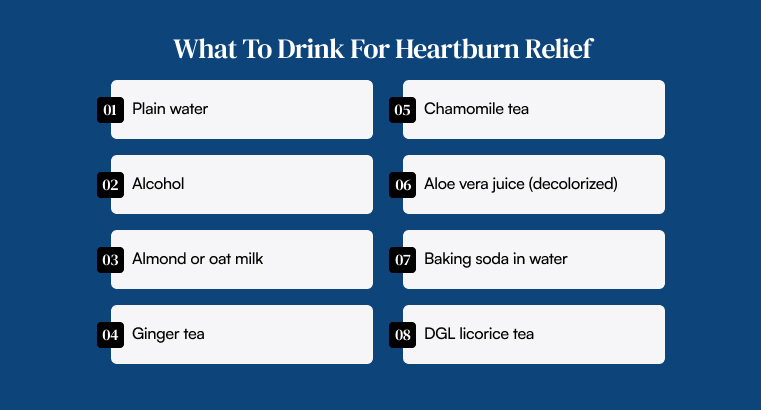
The evidence for home remedies is usually mixed, with much of it coming from small studies or from long traditional use.
Some options are reasonable for occasional symptoms. On the other hand, others need caution.
Below is the table that gives a quick overview, followed by details on each one.
| Drink | How it may help | Strength of evidence | Main caution |
| Plain water | Dilutes and clears acid from the esophagus | Moderate | Large amounts at once can worsen reflux |
| Low-fat or skim milk | Briefly buffers acid | Limited | Whole milk can trigger more acid |
| Almond or oat milk | Gentle, low-acid alternative | Limited | Check for added sugar and fat |
| Ginger tea | May ease stomach irritation and speed emptying | Limited to moderate | High doses can irritate the stomach |
| Chamomile tea | Calming, may soothe the gut | Limited | Allergy risk if you react to ragweed |
| Aloe vera juice (decolorized) | May soothe the lining | Limited, small studies | Must be purified; can cause diarrhea |
| Baking soda in water | Neutralizes acid fast | Strong for short-term relief | High in sodium; not for regular use |
| DGL licorice tea | May protect the lining | Limited | Regular licorice can raise blood pressure |
Plain Water
Water is known as the simplest option. Not just that, but it is also a good first move.
By taking small sips, you can help wash acid from the esophagus back into the stomach. It can then dilute what is sitting there.
Instead of gulping it down, try to sip slowly. That is because a big volume at once will only end up stretching the stomach, while triggering more reflux.
So, for most people, room temperature or cool water tends to work best for most people.
Low-Fat Milk And Plant Milks
Milk usually feels soothing, and a small glass of skim milk or low-fat milk can briefly buffer acid.
However, the relief can be short-lived. That is because protein and fat in milk may stimulate more acid afterward. But remember one thing.
Whole milk is considered the worst of these. This is because fat tends to slow stomach emptying while relaxing the LES. Here, almond milk and oat milk are considered popular substitutes, and many people tolerate them well.
So, try choosing unsweetened versions, because added sugar and flavorings can undo the overall benefit.
Ginger Tea
Ginger is known for having a long history as a digestive aid. In fact, there are certain studies that suggest it helps the stomach to empty faster.
This means less time for acid to build up.
Start by steeping a few thin slices of fresh ginger in hot water for about 10 minutes. Also, try to drink it warm and not hot.
Keep the amount modest, roughly one gram of ginger a day. That is because too much can cause heartburn itself.
Ginger can also interact with blood-thinning medicine. So, check with your doctor if you take one.
Chamomile, Fennel, And Slippery Elm
These are the gentle herbal choices. First of all, chamomile is calming and helps ease cramping.
On the other hand, fennel tea is traditionally used for bloating and gas.
Slippery elm forms a slick, gel-like coating when it is mixed with water. This is the reason why people use it for sore throats and reflux.
Do note that research on all three is limited. However, they are low-risk for most adults.
Still, try to introduce one at a time. In that way, you can tell which helps and which does not.
Aloe Vera Juice
According to small studies, purified aloe vera juice may reduce reflux symptoms. That is possibly by soothing the lining of the esophagus.
So, look for a product labeled decolorized or purified. That is because the whole-leaf version contains latex. This acts as a strong laxative.
So, start with a small amount. This would be about a quarter cup. Now, see how much your stomach reacts to it.
If you have kidney issues or take diabetes medicine, try to consult a medical professional first.
Baking Soda In Water
Chemically termed sodium bicarbonate, baking soda is actually an antacid. The main purpose of this is to neutralize stomach acid quickly.
Usually, the main approach to follow is half a teaspoon stirred into a glass of water. Sip that slowly and not more than a few times a week.
It is for occasional use only. That is because it is high in sodium, which can cause bloating, gas, or a rebound increase in acid.
So, avoid it if you have high blood pressure, heart disease, or kidney disease, or are pregnant. Do so unless your doctor agrees.
Never use it right after a very large meal. That is because the gas it produces can be quite dangerous with a full stomach.
DGL Licorice Tea
Deglycyrrhizinated licorice (DGL) has had the compound glycyrrhizin removed.
That is exactly the part that raises blood pressure and lowers potassium.
Usually sold as chewable tablets or tea, some people find it protective for the stomach lining.
Regular licorice tea is a different product and should not be a daily habit, especially with blood pressure problems. Thus, check labels carefully before buying.
Drinks That Can Make Heartburn Worse
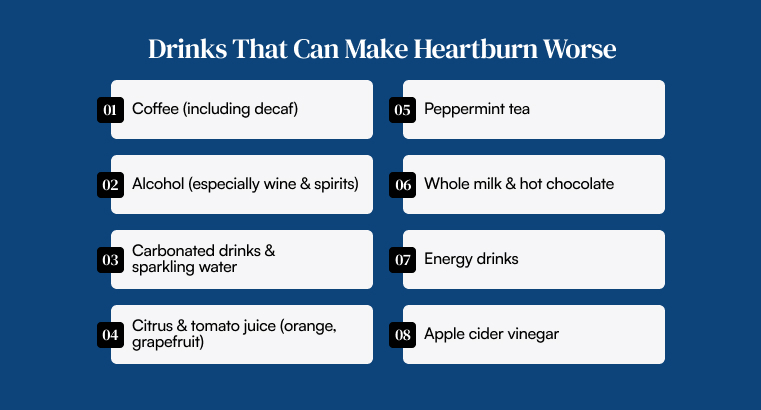
The knowledge of what to avoid is just as useful as knowing what you should drink.
In case you take the wrong drink while already having a burning chest, you can undo any relief.
Below, you can find the lists of the usual offenders and why they cause trouble.
| Drink | Why It Can Trigger Heartburn |
| Coffee (including decaf) | Stimulates stomach acid and may relax the lower esophageal sphincter (LES). |
| Alcohol (especially wine & spirits) | Relaxes the LES and directly irritates the stomach lining. |
| Carbonated drinks & sparkling water | Gas expands the stomach, building pressure that pushes acid upward. |
| Citrus & tomato juice (orange, grapefruit) | Highly acidic, causing direct irritation to the esophagus. |
| Peppermint tea | Relaxes the LES, despite its soothing reputation. |
| Whole milk & hot chocolate | High fat content slows stomach emptying and may increase acid production. |
| Energy drinks | Packs a triple threat of caffeine, high acidity, and carbonation. |
| Apple cider vinegar | Highly acidic and can burn the throat; popular online but lacks scientific backing. |
The Peppermint And Vinegar Myths
There are two remedies that deserve special mention.
Peppermint feels cooling.
However, it can relax the LES and make reflux more likely. In addition, it is a poor choice for heartburn specifically.
Apple cider vinegar is widely recommended online. However, there is no solid research showing it works.
Also, drinking acid when your esophagus is already irritated is counterproductive. If you want to try it, speak to a doctor first.
How To Drink For Relief: Timing And Habits
What you drink matters, but so do the temperature, the amount, and the timing.
Small adjustments can make a good drink work better and a mediocre one less harmful.
Most of these habits are free and take little effort.
Sip, Do Not Gulp
Large volumes of liquid fill the stomach quickly and increase pressure on the LES. Take small sips and pause between them.
If you need to drink with meals, keep the amount modest and drink most of your fluids between meals instead.
Warm Drinks: Not Hot Or Ice-Cold
Very hot drinks can irritate an already sore esophagus. On the other hand, ice-cold drinks may trigger spasms in some people.
Lukewarm or comfortably warm is usually the safest range.
What To Drink For Heartburn Relief At Night
Nighttime heartburn is common because lying flat makes it easier for acid to rise.
A small cup of warm ginger or chamomile tea an hour or two before bed is a gentler choice than heavy milk or alcohol.
Avoid large drinks within two to three hours of lying down.
Raising the head of your bed by six to eight inches, or sleeping on your left side, also helps, and these changes often work better than any drink.
Other Home Remedies Beyond Drinks
Drinks work best as part of a larger plan. If you get heartburn more than occasionally, these habits do more over time than any cup of tea:
- Eat smaller meals and stop eating two to three hours before bed.
- Identify your triggers, where common ones include fried food, chocolate, onion, garlic, spicy dishes, and large portions.
- Chew sugar-free gum after a meal, since it increases saliva, which neutralizes acid.
- Maintain a healthy weight because extra abdominal pressure pushes acid upward.
- Avoid tight clothing around the waist.
- Quit smoking, which weakens the LES.
- Stay upright for at least two hours after eating.
Over-the-counter antacids, such as calcium carbonate, work quickly for occasional symptoms.
Acid reducers like famotidine or proton pump inhibitors take longer and are meant for frequent heartburn.
However, they should be used under guidance if needed for more than two weeks.
When Home Remedies Are Not Enough
Occasional heartburn after a heavy meal is common and usually harmless.
However, heartburn that happens more than twice a week, or that needs daily remedies, may be gastroesophageal reflux disease (GERD).
Left untreated, constant acid can inflame the esophagus, cause narrowing, and in some people lead to changes in the lining known as Barrett’s esophagus.
Home drinks cannot treat these problems. So, persistent symptoms deserve a proper evaluation.
Chest pain is another reason to be careful. Heartburn and a heart attack can feel similar, and people often guess wrong.
Never assume a burning chest is only acid if it comes with other warning signs.
When To See A Doctor

Book an appointment if:
- You have heartburn more than twice a week
- Symptoms continue despite lifestyle changes and over-the-counter medicine
- You have needed antacids for more than two weeks.
- You have trouble swallowing, a lasting cough or hoarse voice, or a sour taste that keeps returning
Also, seek urgent care for unexplained weight loss, repeated vomiting, black or bloody stools, or vomit that looks like coffee grounds.
Call emergency services right away if burning in your chest comes with the following:
- Pressure or tightness
- Pain spreading to the arm, jaw, or back
- Shortness of breath
- Sweating
- Dizziness
The best answer to what to drink for heartburn relief is usually the least exciting one:
- Small sips of water
- A cup of ginger or chamomile tea
- A little low-fat milk.
Use stronger options like baking soda sparingly, steer clear of the drinks that fan the fire, and treat frequent heartburn as a signal worth investigating.
Remember to never treat it as just something to wash down.
Disclaimer: The information provided in this article is for general informational purposes only. It does not, and is not intended to, constitute medical or health advice. Please consult a qualified healthcare professional for medical guidance or expert health assistance.
References
- Heartburn: What you need to know | NIH MedlinePlus Magazine. (n.d.). NIH MedlinePlus Magazine.
- Acid reflux (GER & GERD) in adults – NIDDK. (n.d.). National Institute of Diabetes and Digestive and Kidney Diseases.
- Goosenberg, E., & Vadakekut, E. S. (2025, July 6). Gastroesophageal reflux Disease (GERD). StatPearls – NCBI Bookshelf.
- Heartburn. (2025, December 19). Cleveland Clinic.
- NHS.UK. (2026, August 17). Heartburn and acid reflux. nhs.uk.
What is your reaction?