 By
In today’s world, we are defined by digitalisation. In fact, no matter what we do, everything involves widespread use of technology, global internet connectivity, and data-driven technologies.
Be it for studying, working, or leisure, everyone is dependent on some sort of device. In India, roughly 958 million people are active internet users, where 57% of those are revealed to be from rural India. Over 85.5% of households have access to at least one smartphone, meaning nearly the entire population lives in a home with some kind of phone.
Not only that, but the majority of us have to be behind a screen throughout the day. We spend hours staring at glowing screens every single day, from early morning emails to late-night scrolling.
So, of course, it is no surprise that many of us end up with dry and tired eyes, nagging headaches, and restless nights.
Now, enter blue light glasses that promise to block harmful rays, relieve digital eye strain, and protect your sleep. They have become a must-have accessory for screen users everywhere. However, before you invest in a pair, you need to ask one simple question: Do blue light glasses work?
Also, are these specially coated lenses genuinely backed by eye care science? Or are they just clever marketing?
In this guide, we will break down how blue light actually affects your vision, separate the myths from the proven facts, and share smarter ways to keep your eyes comfortable. But remember the decision to wear them is always yours!
Health Snapshot:
• Blue light glasses do not significantly reduce digital eye strain compared to regular glasses
• Dark amber blue light glasses improve sleep quality when worn two hours before bedtime
• Clear blue light glasses fail to protect sleep due to blocking under 25% of blue light
• Blue light glasses are unnecessary for retinal health as screens do not cause eye damage
• They do not fix reduced blinking, the main cause of eye strain
• The 20-20-20 rule relieves digital eye strain more effectively than wearing blue light glasses
What Exactly Are Blue Light Glasses

Let us understand what these glasses are.
So, blue light glasses are specialised eyewear that is built with surface coatings or tinted lenses. Moreover, these are designed to reflect, filter, and absorb short-wavelength blue light emitted by digital screens before it reaches your eyes.
Often marketed as “computer glasses” or blue blockers,” they come in both prescription and non-prescription frames. In that context, non-prescription frames mean the ones with zero power.
Now, on the basis of how much blue light they are actually engineered to block, the lenses may appear almost completely clear with a subtle anti-reflective screen or carry a noticeable yellow to amber tint.
The Connection With Blue Light
Before we can get a deep understanding of what these glasses even do, it would help to first look at their main target Blue light.
So, blue light is actually a natural, high-energy, and short-wavelength band on the visible light spectrum, which sits right next to ultraviolet (UV) rays.
Generally, blue light is considered to be bad for you. In reality, while smartphones, laptops, televisions (especially the ones with vibrant LCD screens), and LED bulbs all emit blue light, the sun remains our largest and most powerful source of exposure.
During the daytime, natural blue light is actually beneficial. Actually, it boosts alertness, elevates mood, and regulates your circadian rhythm. That is actually your body’s internal sleep-wake clock.
However, when you get prolonged exposure to concentrated artificial blue light from screens at a close range, it can confuse your brain into thinking it is still daytime. As a result, it suppresses the sleep hormone, melatonin.
And this is especially for all the night owls!
Common Usage
Now, it is a fact that blue light glasses are safe to wear all day and widely accessible either over the counter or through opticians. So, people can use them in two different ways.
- All-day screen work
- Evening wind-down
Now, when it is for all-day screen work, mild-filtration lenses are used. Actually, these are nearly clear, causing minimal colour distortion. Additionally, they are more commonly worn during daytime work or study hours by office professionals, students and gamers.
On the other hand, for evening wind-down, where high filtration lenses are used, it features a strong yellow or amber tint. Typically, these are worn 1 to 3 hours before bedtime during activities such as watching TV, working late shifts, or scrolling on a smartphone.
Why Are They Used?
Most people use blue light glasses to counter Computer Vision Syndrome (CVS). Commonly, this is known as digital eye strain and generally comes along with sleep disruption.
Below is a quick breakdown of the primary reasons people use them and what the lenses are intended to do.
| Primary Goal | The Issue It Targets | How The Glasses Are Intended To Help |
| Ease Digital Eye Strain | Dry, red, sore, or fatigued eyes after hours of staring at digital displays | Softens harsh LED screen glare and reduces visual fatigue during long sessions |
| Protect Sleep Quality | Difficulty falling asleep after late-night studying, gaming, or scrolling | Blocks evening blue wavelengths that suppress melatonin production |
| Reduce Screen Headaches | Tension headaches and light sensitivity triggered by bright monitors | Filters out high-energy, short-wavelength light that can overstimulate the eyes |
| Long-Term Retinal Care | Concerns that cumulative screen exposure could cause long-term eye damage | Acts as a physical barrier to limit high-energy light exposure (though major eye bodies note screens do not cause eye disease) |
Do Blue Light Glasses Work? What Science Says
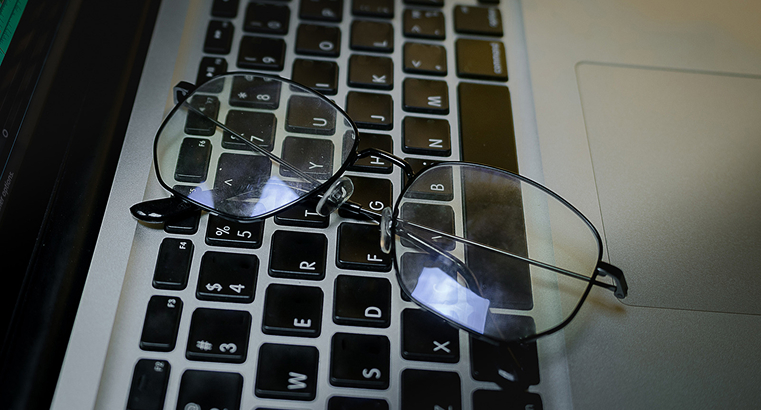
Now, this is definitely true. Blue light glasses do actually physically filter out short-wavelength light.
However, large-scale clinical reviews along with several studies have evaluated that they make little to no measurable difference for everyday digital eye strain or long-term eye health.
Despite that, heavily tinted lenses do still offer real and targeted benefits for evening sleep as well as specific light-sensitive conditions.
So, to understand why eye doctors have scepticism of mainstream marketing but still recommend specific lenses in niche cases, we need to examine what the research says.
Digital Eye Strain
Verdict: Little to no measurable benefit
The thing is, if you are buying blue light glasses for stopping your eyes from aching after an 8-hour workday, there are no specific benefits that outperform standard glasses.
In fact, a comprehensive review by one study suggested that after analysing 17 randomised controlled trials across six countries, it was concluded that blue-light filtering lenses probably make no short-term difference to eye strain or visual fatigue.
Furthermore, it was stated that there is no specific difference compared to standard, non-filtering lenses.
In another 2021 double-masked study, a total of 120 computer users were involved. Here, participants wore either blue-blocking glasses or clear placebo lenses during a two-hour screen task. In fact, both groups reported nearly identical levels of eye strain and fatigue.
However, some observational surveys show the latter. There are some regular users reporting less eye fatigue. Actually, eye specialists note this relief usually stems from anti-reflective or anti-glare coatings.
This is actually an updated vision prescription or the placebo effect instead of the blue light filter itself.
Sleep And Circadian Rhythm
Verdict: Effective, if the tint is strong enough
It is a known fact that sleep is the one area where blue light glasses have strong biological backing. This is largely due to the specialised photoreceptors in our eyes called intrinsically photosensitive retinal ganglion cells, or ipRGCs, that use blue light.
This blue light plays a key role in telling our brain whether it is day or night.
There is actually this “spectral mismatch” problem. The thing is most popular, clear-lensed blue light glasses only filter out 10% to 25% of light in the 400-450 nm range. However, the eye’s melatonin-suppressing receptors peak around 480 nm.
And since clear lenses miss this peak, they rarely improve sleep.
But they do actually work. The thing is when.
According to several clinical trials, dark amber or orange lenses worn 1.5 to 3 hours before bed can prevent melatonin suppression.
Not only do they shorten the time it takes to fall asleep, but they also help night-shift workers or people with insomnia and delayed sleep phase disorder.
Retinal Protection And Eye Disease
Verdict: Unproven and unnecessary
There are multiple adverts you would see that tend to claim that cumulative blue light from phones and laptops will permanently damage your retina. It can also cause macular degeneration over time. However, major medical bodies firmly reject this.
According to the American Academy of Ophthalmology (AAO), there is no scientific evidence that the light emitted by digital screens causes eye disease or permanent retinal harm.
Intense UV and high-energy light from the sun can damage eyes over a lifetime. But, digital screens emit only a tiny fraction of natural sunlight’s intensity.
Migraines, Light Sensitivity And Neurological Relief
Verdict: Promising, niche use
While general screen users see minimal benefit, smaller clinical studies point to promising niche uses for people with neurological light sensitivity.
Certain wavelengths of blue and amber light overstimulate pain pathways in migraine sufferers.
The Scientific Scorecard At A Glance
| Claim / Area | What the Research Shows | Clinical Verdict |
| Relieves Digital Eye Strain | Multiple RCTs and Cochrane reviews show no meaningful difference over regular clear lenses. | Not Supported |
| Improves Sleep Quality | Clear lenses (10–25% block) fail to protect melatonin; dark amber lenses worn 2 hrs before bed help. | Conditional (Amber Lenses Only) |
| Prevents Retinal Damage | Screen blue light is vastly weaker than sunlight and has not been linked to eye disease. | Not Supported |
| Helps Migraines / Photophobia | Precision-tinted lenses (like FL-41) show promise for light-triggered migraines; standard clear filters are mixed. | Promising (Niche Use) |
| Reduces Screen Glare | Comfort comes from standard anti-reflective coatings, not the blue-light filter itself. | Supported (via Glare Coating) |
Do Blue Light Glasses Have Any Side Effects
Does something actually happen to your vision when you wear these lenses all day?
Actually, recent controlled trials confirm that mild blue-filtering lenses do not significantly harm contrast sensitivity or basic color vision. However, heavy yellow or amber tints noticeably distort blue hues.
As a result, they tend to be suitable for graphic designers, photographers, or night driving.
There are certain clinical trials that have tracked adverse effects and found that side effects are rare and mild.
However, some participants reported temporary headaches, slight visual discomfort, or lowered mood or alertness when blocking blue light during daytime hours.
Types of Blue Light Glasses And What To Keep In Mind When Choosing?
Now, if you still want to try a pair, remember one thing. Blue light glasses come in both prescription and zero-power options. Moreover, experts group them into three main lens types based on how much light they actually block.
| Lens Type | Blue Light Blocked | Best Suited For | How They Can Help |
| Clear Lenses | 10% to 25% | Daytime office workStudying | Where true screen colours matter |
| Yellow-Tinted Lenses | 30% to 50% | Gamers Heavy screen users | To soften harsh monitor contrast |
| Dark Amber / Orange Lenses | 80% to 99% | Night owls Shift workers | Wearing them 1 to 3 hours before bed to protect sleep |
Remember, manufacturers don’t build all blue light lenses to the same standard, so keep the following in mind before buying:
- Try ignoring the blue laser pen test
- Check for a specific nanometer (nm) range
- Look for anti-reflective (AR) coating on both sides for zero distractions in screen reflections
- Get an eye exam first, as it can be uncorrected astigmatism or farsightedness
What Alternatives Can You Consider
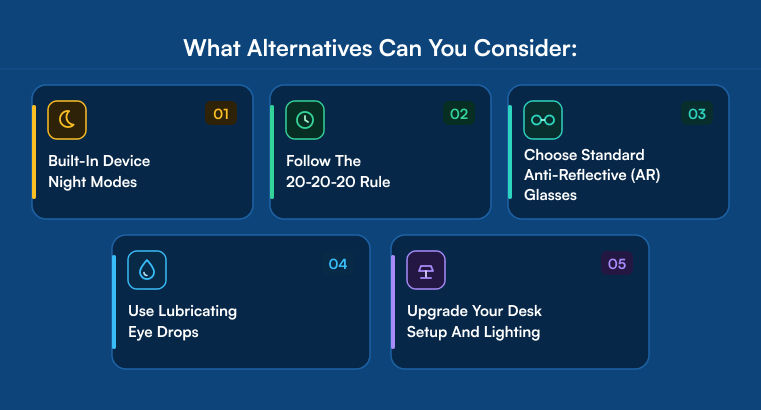
Conversely, if you want to make a decision on just skipping blue light glasses entirely, several direct substitutes tackle screen discomfort more effectively.
In fact, most of them cost nothing.
Built-In Device Night Modes
In almost every smartphone, tablet, and laptop, there is a free built-in blue light filter. Actually, you can choose to enable Night Shift mode on your iPhone. If you have Windows, you can choose Night Light.
On the other hand, for Android, the Eye Comfort Shield will automatically shift your screen to warmer tones in the evening.
Follow The 20-20-20 Rule
This is actually quite a common method anyone can follow for screen discomfort.
So, what you need to do is every 20 minutes, look at an object at least 20 feet away for 20 seconds. Hence, the 20-20-20 rule.
As a result, this will give your eye’s focusing muscles a real break it deserves. This is actually something that tinted lenses cannot do!
Choose Standard Anti-Reflective (AR) Glasses
Another method you can follow is choosing standard AR glasses. Actually, much of the visual comfort credited to blue blockers actually comes from anti-glare coatings.
But regular prescription or zero-power glasses with a quality AR coating cut the harsh reflections from tube lights. Also, it will monitor without distorting screen colours.
Use Lubricating Eye Drops
Did you know? When you stare at your screen, staring tends to cut your blink rate nearly in half.
So, keeping preservative-free artificial tears on your desk will directly relieve dry and gritty eyes.
Upgrade Your Desk Setup And Lighting
First of all, try to keep your monitor an arm’s length away, say about 20 to 24 inches, slightly above your eye level. Moreover, try to avoid using bright screens in a pitch-dark room.
Instead, try to add a matte anti-glare screen protector, allowing to diffuse that overhead glare.
A Smarter Approach Towards Eye Care
So, do blue light glasses work?
Well, the honest answer is totally dependent on what you actually expect from them.
If you are hoping that a pair of clear blue blockers will magically cure daytime eye strain or shield your eyes from permanent damage, the science will tell you to save your money.
On the other hand, if you are bound by your circumstances and are actually struggling to wind down after evening screen time, dark amber blue light glasses worn before bed can help you. In that way, you can genuinely protect your sleep.
In conclusion, lasting eye comfort all boils down to smarter screen habits and not special lens coatings.
Disclaimer:
The information provided in this article is for general informational purposes only. It does not, and is not intended to, constitute medical or health advice. Please consult a qualified healthcare professional for medical guidance or expert health assistance.
References
- Singh, S., Keller, P. R., Busija, L., McMillan, P., Makrai, E., Lawrenson, J. G., Hull, C. C., & Downie, L. E. (2023). Blue-light filtering spectacle lenses for visual performance, sleep, and macular health in adults. The Cochrane Database of Systematic Reviews, 8(8), CD013244. PubMed Central.
- Cochrane. (2023, August 18). Blue-light filtering spectacle lenses for visual performance, macular (back part of the eye) protection, and improving sleep quality. Cochrane.Org; Cochrane Library.
- Singh, S., Downie, L. E., & Anderson, A. J. (2021). Do Blue-blocking Lenses Reduce Eye Strain From Extended Screen Time? A Double-Masked Randomized Controlled Trial. American Journal of Ophthalmology, 226, 243–251. PubMed.
- Vimont, C. (2021). Are computer glasses worth it? American Academy of Ophthalmology.
- Luna-Rangel, F. A., Gonzalez-Bedolla, B., Salazar-Ortega, M. J., Torres-Mancilla, X. M., & Martinez-Cadena, S. (2025). Efficacy of blue-light blocking glasses on actigraphic sleep outcomes: A systematic review and meta-analysis of randomized controlled crossover trials. Frontiers in Neurology, 16, 1699303. Frontiers.
- Del La Luz Torres, V., Coronel, M., Hassaan, S., Varon, J., & Halma, M. (2026). Effects of Blue Light Blocking Glasses on Visual Performance, Sleep, Neuroendocrine Regulation: A Narrative Review. Journal of Multiscale Neuroscience, 5(1), 20–29. ResearchGate.
- Sadeghi M, Rahmani S, Ghasemi Brumand M, Dibajnia P. The Effect of Blue-Light-Blocking Filters on Human Visual System Performance and Individual Characteristics: A Narrative Review. Journal of Modern Rehabilitation. 2026; 20(2):103-118. Journal of Modern Rehabilitation.
What is your reaction?