 By
Now, look. Whether you are taking a morning round at your local park or pacing inside your living room during a phone call, walking is easily the most popular workout in India.
Almost everyone with a smartwatch or a fitness app on their phone has seen that glowing ring urging them to hit 10,000 steps before bedtime. Moreover, it feels like a universal rule of good health.
However, when you actually sit down to ask how many steps to walk per day, the real answer is far less intimidating than your fitness tracker makes it sound.
So, you do not need to walk for two hours every day to protect your heart or manage your weight. In fact, modern medical science shows that the sweet spot for the majority of people sits comfortably below that famous five-digit mark.
Let us now break down the truth behind daily step counts, how to tailor them to your age and health, and simple ways to fit more movement into a busy Indian routine.
Health Snapshot:
• 7,000 to 8,000 steps daily delivers major protection against heart disease, diabetes, and early mortality.
•The famous 10,000-step rule started as a 1960s Japanese marketing campaign instead of a medical study.
• Walking fewer than 5,000 steps a day classifies your lifestyle as sedentary.
• The addition of just 1,000 extra steps to your current daily average noticeably improves heart health.
• Short 10-minute walks right after lunch and dinner help control Indian post-meal blood sugar spikes.
Where Did The 10,000 Steps Rule Come From

Actually, we all have heard that. But wait! Where did this rule even come from?
So, the thing is that most people have assumptions that doctors or scientists have probably sat in a lab and proved that 10,000 is the magic number for human survival. However, in reality, that target was born out of clever advertising.
Let us go back in history for a while! Back in 1965, right after the Tokyo Olympics took place, a Japanese company launched one of the world’s first commercial pedometers (Sweiss, 2026).
In addition, this gadget was named Manpo-kei, which literally translates to “10,000-steps meter.” The company picked this round figure simply because it sounded catchy and the Japanese character for 10,000 looked a bit like a person walking.
Over the decades, smartphone makers and smartwatch brands adopted that exact number as their default daily goal. While walking 10,000 steps is certainly healthy, treating it as a strict pass-or-fail test often tends to backfire.
If you work a desk job in Bengaluru or spend two hours stuck in Mumbai traffic, hitting 10,000 steps would require roughly 90 minutes of dedicated walking. So, when people repeatedly miss that target, they get discouraged and stop trying altogether.
What Science Actually Says About Daily Step Counts
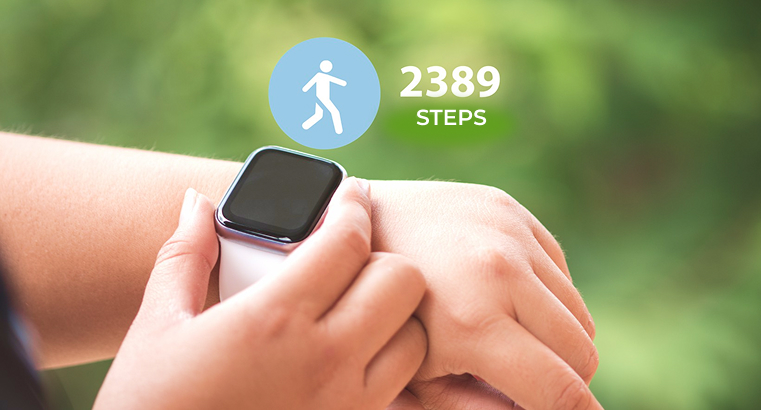
Over the past few years, global researchers have tracked hundreds of thousands of adults to see how daily step counts truly affect long-term health. The findings are a huge relief for anyone struggling to find spare time.
In addition, a major research review published in The Lancet (2025) revealed that walking 7,000 steps per day helps you immensely in cutting the risk of premature death by nearly half compared to walking just 2,000 steps. Also, it significantly lowers the risk of heart disease, type 2 diabetes, and dementia.
Even more encouraging is how quickly the benefits start to appear. In fact, as per the studies reviewed by the British Heart Foundation (2026), measurable heart protection starts at around 2,500 to 4,000 steps a day.
Actually, every extra 500 to 1,000 steps you add plays a notable role in dropping your cardiovascular risk even further. For the majority of adults, health benefits begin to level off between 7,500 and 8,500 steps.
When you go beyond that, it is completely fine if you enjoy it. However, you do not need to stress over hitting five digits every single night.
| Daily Step Range | Activity Level | What It Means for Your Health |
| Under 5,000 steps | Sedentary | Common among desk workers; linked to higher risks of weight gain and metabolic issues. |
| 5,000 to 6,999 steps | Low Active | A solid starting zone that noticeably lowers heart risks compared to sitting all day. |
| 7,000 to 8,999 steps | Moderately Active | The science-backed sweet spot for longevity, heart protection, and blood sugar balance. |
| 9,000 to 10,000+ steps | Active | Ideal for weight management, stamina building, and high-calorie-burn fitness goals. |
How Many Steps To Walk Per Day Based On Your Goals
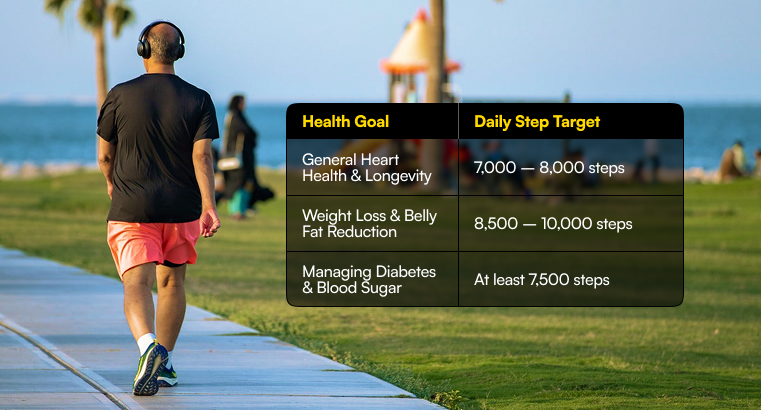
Since everyone has a different body, schedule, and medical history, your ideal step target should match what you are trying to achieve.
For General Heart Health And Longevity
If your main goal is simply to stay fit, keep your blood pressure steady, and live a long life, aim for 7,000 to 8,000 steps per day. In Indian distance terms, this equals roughly 5 to 6 kilometers spread across your entire day.
That total includes everything from walking to the kirana store to taking stairs at the metro station.
For Weight Loss And Belly Fat Reduction
Walking is gentle on the joints. This makes it a safe way to burn extra calories without risking gym injuries. In case you want to shed weight, try to aim for 8,500 to 10,000 steps per day.
In addition to this, you also need to pay close attention to your walking speed.
For example, if you are going for a slow evening stroll while scrolling on your phone, you will end up burning far fewer calories than a brisk walk. So, try to make at least 3,000 of those steps brisk enough that your heart beats faster and you feel slightly out of breath.
Ultimately, remember that walking works best when paired with sensible portion control, especially when you cut back on refined carbs, fried snacks and sugary chai. Please try to cut down on that sugar!
For Managing Diabetes And Blood Sugar
Did you know this quite embarrassing and unfortunate fact? India is known as the diabetes capital of the world often times, where daily movement is one of the strongest natural tools to improve insulin sensitivity.
Health guidelines for adults managing type 2 diabetes recommend avoiding sedentary days under 5,000 steps and aiming for at least 7,500 steps daily.
More importantly, timing matters just as much as total volume.
So, taking a brisk 10-to-15-minute walk right after lunch and dinner plays an immensely significant function to help your leg muscles absorb glucose directly from your bloodstream. As a result, it allows in preventing sharp post-meal sugar spikes.
Step Targets By Age Group
Your body actually has a lot of changes over time. In fact, your daily step expectations should adjust in a comfortable manner alongside it.
| Age Group | Recommended Daily Target | Practical Focus |
| Children & Teens (6–17 years) | 10,000 to 12,000 steps | Active outdoor play, sports, and limiting screen time. |
| Adults (18–59 years) | 7,000 to 10,000 steps | Mixing daily movement with 30 minutes of brisk walking. |
| Seniors (60+ years) | 6,000 to 8,000 steps | Consistent, steady movement on flat surfaces to protect joints and balance. |
Why Briskness Matters Just As Much As Step Count

Imagine this first. There are two people who both finish their day with 7,500 steps. Now, it is then revealed that the first person just shuffled slowly around their house while doing chores.
In the case of the second person, however, they walked at a steady, purposeful pace in the morning sun.
Now, even though their fitness watches display the exact same number, the second person gets far stronger cardiovascular and fat-burning benefits.
Fitness experts define brisk walking as moving roughly at 100 steps per minute. So, you do not need a stopwatch to measure this. For this, you can simply use the “talk test” during your walk.
The talk test is when you should be able to hold a normal conversation with a walking partner. However, you should also feel too breathless to sing a song.
Following the standard recommendation offered by the World Health Organization, 150 minutes of moderate weekly activity translates to roughly 30 minutes of brisk walking five days a week.
Practical Ways To Hit Your Step Goal In India
Between scorching summer heat, monsoon downpours, stay traffic, and long office hours, stepping outside for an hour is not always easy in Indian cities.
Fortunately, your body does not care whether you earn steps in one long stretch or in tiny five-minute bursts.
| Strategy | How to Do It | Key Benefits |
| Adopt the Shatapavali Tradition | Take a 10-minute stroll around your society compound or balcony after meals | Easily adds 1,000 to 1,200 steps a day while aiding digestion |
| Walk While You Talk | Pace across your bedroom or office corridor during phone calls instead of sitting | Quietly adds over 1,200 steps in a 15-minute call without taking extra time out of your schedule |
| Rethink Short Commutes | Walk instead of driving or taking a scooter for errands (milk, vegetables, medicines) within 1 km | Adds nearly 1,500 steps in a 10-minute round trip and saves fuel |
| Use Indoor Spaces During Bad Weather | Walk in shopping malls, apartment hallways, covered parking, or in place while watching TV during heavy rains or extreme heat | Keeps your daily step streak alive regardless of the weather |
| Take the Stairs for Two Floors | Skip the lift when going up or down two to three floors at home or work | Works leg muscles harder and boosts your heart rate faster than flat walking |
Every Step Counts Toward Better Health: How To Build Your Walking Habit Safely
If your phone currently shows an average of 2,500 steps a day, jumping straight to 8,000 tomorrow will only leave you with sore calves, heel pain, and exhaustion.
So, treat your step goal as if it’s like building savings. That is because slow, steady deposits work best.
Try to check your smartphone’s built-in health app over the next three days to find your honest baseline. Once you know your starting number, add just 500 to 1,000 extra steps per day for the first week. This would help you get ten minutes of extra movement.
Also, once that feels effortless, bump your target up by another 500 steps the following week. Then, go on to invest in a pair of well-cushioned walking shoes instead of flat chappals or worn-out sandals.
This is especially true if you walk on hard concrete footpaths. Always remember that good footwear protects your knees and heels in a way where you enjoy walking pain-free for decades.
Disclaimer:
The information provided in this article is for general informational purposes only. It does not, and is not intended to, constitute medical or health advice. Please consult a qualified healthcare professional for medical guidance or expert health assistance.
References
- Sweiss, C. (2026, April 3). The 10,000 Step Myth: What Actually Matters. National University Of Health Sciences.
- Ding, D., Nguyen, B., Nau, T., Luo, M., del Pozo Cruz, B., Dempsey, P. C., Munn, Z., Jefferis, B. J., Sherrington, C., Calleja, E. A., Hau Chong, K., Davis, R., Francois, M. E., Tiedemann, A., Biddle, S. J. H., Okely, A., Bauman, A., Ekelund, U., Clare, P., & Owen, K. (2025). Daily steps and health outcomes in adults: a systematic review and dose-response meta-analysis. The Lancet Public Health, 10(8), e668–e681. The Lancet Public Health.
- Goss, R. (2026, November 12). How many steps a day should I walk for my heart health. British Heart Foundation.
- Banach, M., Lewek, J., Surma, S., Penson, P. E., Sahebkar, A., Martin, S. S., Bajraktari, G., Henein, M. Y., Reiner, Ž., Bielecka-Dąbrowa, A., & Bytyçi, I. (2023). The association between daily step count and all-cause and cardiovascular mortality: A meta-analysis. European Journal of Preventive Cardiology, 30(18), 1975-1985.
- World Health Organization: WHO. (2026, November 4). Physical activity. Who.Int; World Health Organization: WHO.
What is your reaction?