 By
If you have PCOS, ask a roomful of people about their health. You will be surprised to find that there are numerous people talking about a second diagnosis. This could be Hashimoto’s thyroiditis, celiac disease, lupus or psoriasis.
This has made many people wonder: is PCOS an autoimmune disease?
To put it simply, no, PCOS (now known as PMOS) is not an autoimmune disorder.
But it doesn’t mean that your immune system is sitting on the sidelines just because it isn’t an autoimmune disease.
Furthermore, studies have repeatedly demonstrated that individuals with PMOS have a significantly increased risk of developing some autoimmune diseases compared to those without PMOS.
With the overlapping symptoms of persistent fatigue and hair loss, chronic low-grade inflammation, and shifting hormones, it can be difficult to distinguish between the two.
To understand the overlap of these conditions, it’s important to first understand why the name recently changed. Also, why that new label is a big hint as to how the condition works.
Wait! Why Are We Even Calling It PMOS Instead Of PCOS?
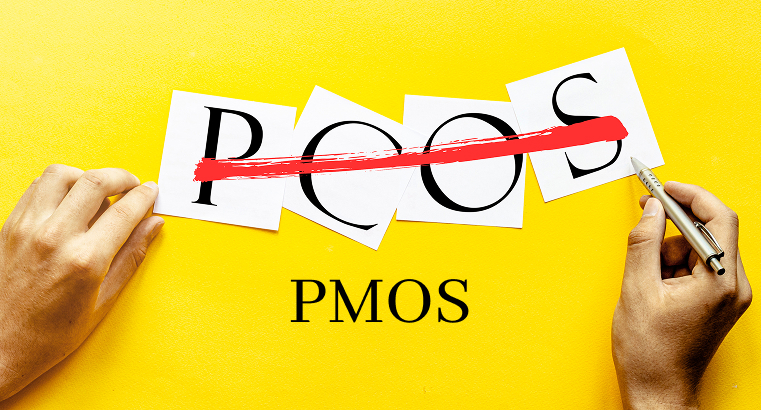
If you have been diagnosed with PCOS, or Polycystic Ovary Syndrome, you haven’t been diagnosed with a new medical condition. Rather, you are now viewing the same disorder, but this time under a more apt name.
After 14 years, with the help of international researchers, clinicians and patient advocates, the condition was officially renamed Polyendocrine Metabolic Ovarian Syndrome (PMOS) in The Lancet.
The old name was a source of confusion for decades. This is because it would lead people to believe that it was just an ovarian problem due to harmful cysts.
So, the new name corrects the misconception and emphasizes what is actually going on in the body. What changed then?
The terminology changed from the misleading “ovarian cysts” to immature follicles. This highlights the whole-body hormonal (polyendocrine) and metabolic causes of the condition, including insulin resistance and androgen excess.
There were some things, however, that remained constant. Your diagnosis, underlying biology, diagnostic criteria, and treatment options are all the same. Furthermore, you can expect to continue to see PMOS and PMOS on lab reports and prescriptions during the worldwide shift.
Therefore, knowing this change makes it much easier to answer the autoimmune question. This is because the new name highlights the endocrine and metabolic systems that are responsible for the condition.
The Core Problem Is Hormonal And Metabolic
PMOS is characterized by an imbalance of signals from the brain to the ovaries, and the ovaries overproduce androgens. This is exacerbated by high insulin which causes the ovaries to make even more.
This leads to irregular periods, acne, excessive hair growth, thinning hair on the scalp and sometimes weight loss. None of this is an attack on healthy tissues by the immune system.
Why Is It Called A Syndrome?
Syndromes are a set of signs that occur together but have no single cause.
Furthermore, there are multiple contributing factors to PCOS such as insulin resistance, hormone signaling and genetics, and each individual will have different contributing factors. That’s also why two PMOS can be very different from each other.
Is PMOS An Autoimmune Disease? The Direct Answer
Well, to put it in the most succinct manner possible, no.
An autoimmune disease occurs when the immune system targets the body’s own tissues as an enemy. Consequently, it generates certain antibodies or immune cells that target that tissue.
Examples include:
- Type 1 diabetes
- Hashimoto’s thyroiditis
- Lupus
- Rheumatoid arthritis
There is no single self-attacking process behind PMOS and there is no antibody test to diagnose it. The two are compared side by side in the table below.
| Feature | PCOS | Autoimmune disease |
| Main mechanism | Hormone imbalance, insulin resistance, ovulation problems | Immune system attacks the body’s own tissue |
| Classification | Endocrine and metabolic condition | Immune-mediated condition |
| Defining test | Hormone levels, ultrasound or AMH, symptom pattern | Specific autoantibodies in many cases (for example, TPO antibodies) |
| Typical features | Irregular periods, acne, excess hair, ovarian changes | Depends on the organ attacked, such as thyroid, joints, or skin |
| Core treatments | Lifestyle, metformin, hormonal therapy | Immune-modulating or replacement therapy, depending on the condition |
Is PMOS An Autoimmune Disease In Some People?
A few researchers have wondered if there is an autoimmune component to a subset of PMOS.
That is, for instance, by means of antibodies against the ovary. Small studies have found raised autoantibodies in some.
But some findings are not consistent, and there is no major guideline that considers PMOS as an autoimmune disease. The current opinion is that PMOS is not an autoimmune disease per se, although immune activity may be a contributing factor in some instances.
What About “Inflammation”?
Many people with PMOS have chronic low-grade inflammation, shown by slightly raised markers such as C-reactive protein. This is not the same as autoimmunity.
Instead, it is often linked to excess abdominal fat and insulin resistance. Moreover, it can improve with weight loss, exercise, and better sleep. Of course, it should be noted that inflammation is a shared feature of many conditions. Thus, seeing it does not make PMOS autoimmune.
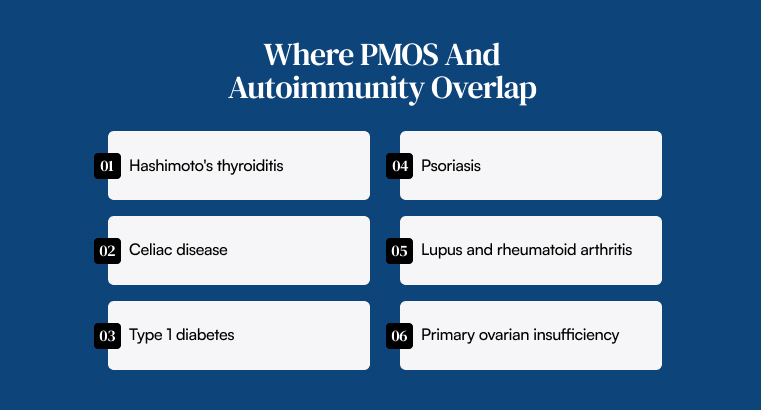
Where PMOS And Autoimmunity Overlap
Chronic low-grade inflammation is present in many people with PMOS, evidenced by slightly elevated inflammatory markers (C-reactive protein). This is not a form of autoimmunity.
Rather, it is associated with an overweight belly and insulin resistance. Furthermore, it can get better as a result of weight loss, exercise, and better sleep. It should be noted, however, that inflammation is a common symptom of many ailments.
So, it is not autoimmune if you see it.
| Autoimmune Condition | Link With PCOS | What To Know |
| Hashimoto’s thyroiditis | Most consistent link; several studies find it about two to three times more common | Causes an underactive thyroid, fatigue, weight gain, and irregular periods |
| Celiac disease | Some studies show a higher rate | Can cause bloating, anemia, and fertility problems |
| Type 1 diabetes | Higher PCOS rates reported in this group | Often involves insulin dosing, which can affect ovarian hormones |
| Psoriasis | Reported more often in some studies | Possibly through shared inflammation and weight-related factors |
| Lupus and rheumatoid arthritis | Mixed evidence; some studies suggest a modest increase | Evidence is weaker than for thyroid disease |
| Primary ovarian insufficiency | Different condition; sometimes autoimmune | Early loss of ovarian function, not the same as PCOS |
The Thyroid Connection
The strongest and best documented overlap is with Hashimoto’s. Both conditions are much more prevalent in women and both can result in fatigue, weight gain or loss, thinning hair and cycle issues. So, one can be behind the other.
Weight loss may also be difficult with an underactive thyroid, and the symptoms of PMOS may be exacerbated.
That is why doctors test thyroid function, and sometimes TPO antibodies, when they are doing a PMOS.
Why Women Are At Higher Risk Of Both
By definition, PMOS is more common in women than men, and so are autoimmune diseases. Immune cells are affected by sex hormones like estrogen.
But this does not mean that one is a form of the other, only that the two have a common hormonal heritage.
Why The Symptoms Can Be So Easy To Confuse
There are many common symptoms that can occur in both PMOS and autoimmune disorders, making it difficult for people to determine what is causing what.
The pattern helps, and the table below indicates where the overlap is.
| Symptom | PCOS | Autoimmune thyroid disease | Other autoimmune disease |
| Fatigue | Common | Very common | Common |
| Weight gain | Common | Common (underactive thyroid) | Varies |
| Irregular periods | Defining feature | Possible | Possible, especially with ovarian involvement |
| Hair thinning | Common (androgen-related) | Common | Possible (for example, alopecia areata or lupus) |
| Acne and excess facial hair | Common | Rare | Rare |
| Joint pain or swelling | Not typical | Possible | Typical in rheumatoid arthritis and lupus |
| Skin rashes or mouth sores | Not typical | Rare | Typical in lupus and psoriasis |
| Brain fog and low mood | Common | Common | Common |
Clues That Point Beyond PMOS
If you tend to have the following signs, then it can be suggested that you have an autoimmune process:
- Joint pain with swelling
- Morning stiffness
- A facial rash that worsens in sunlight
- Recurrent mouth ulcers
- Unexplained fevers
- Patchy hair loss in round bald spots
However, if you have swollen front of your neck, feel cold all the time, or have very dry skin, it’s more likely to be the thyroid.
Any symptom not typical of PMOS should be included.
Is PMOS An Autoimmune Disease When Hair Loss Is The Main Symptom?
Hair loss is a good example of why the question comes up. PMOS thins the hair on the top of the scalp through androgens, usually in a gradual, widening pattern.
Alopecia areata, which is autoimmune, causes sudden round patches of loss. Hashimoto’s can thin hair all over.
A doctor can tell these apart by examining the scalp and ordering blood tests.
How Doctors Check For Both
There is no single test for “autoimmune PMOS.”
Instead, the workup looks at the hormone picture first, then screens for conditions that commonly appear alongside it. Thus, testing is guided by your symptoms and history, not done for everyone.
Tests For PMOS
Diagnosis uses your cycle history, a physical exam for signs of high androgens, and blood tests for testosterone and related hormones.
A pelvic ultrasound can check the ovaries, and in adults, an AMH blood test may be used in place of an ultrasound under the 2023 international guideline.
Doctors also rule out similar problems, such as thyroid disease, high prolactin, and late-onset congenital adrenal hyperplasia.
Tests For An Autoimmune Condition
If symptoms or risk factors suggest one, your doctor may check TSH and free T4 for thyroid function, along with TPO antibodies for Hashimoto’s.
Other options include tissue transglutaminase antibodies for celiac disease, an antinuclear antibody (ANA) test for lupus-type disease, and inflammatory markers.
Fasting glucose, HbA1c, and cholesterol are also commonly checked, since insulin resistance is so common in PMOS.
Does It Change Treatment?
Yes, because treating a second condition often improves PMOS symptoms. The main PMOS treatments stay the same, but extra steps may be added if an autoimmune condition is found.
Having both does not mean the outlook is poor, and many people manage the two well together.
| Situation | Typical Approach |
| PCOS alone | Lifestyle changes, metformin or hormonal therapy as needed, and treatment of acne and hair symptoms |
| PCOS with Hashimoto’s | Thyroid hormone replacement (levothyroxine) plus usual PCOS care, with regular thyroid level checks |
| PCOS with celiac disease | Strict gluten-free diet, along with a nutrition review for iron and vitamin deficiencies |
| PCOS with type 1 diabetes | Careful insulin management, with close attention to weight and menstrual cycles |
| PCOS with psoriasis or arthritis | Specialist care for the skin or joints, plus checks on how any medicine affects fertility and pregnancy |
Lifestyle Steps That Help Either Way
Whether or not you have an autoimmune condition, the basics matter. A Mediterranean-style diet rich in vegetables, legumes, fish, and whole grains supports insulin sensitivity and lowers inflammation.
Regular exercise, including strength training, improves insulin response, and seven to nine hours of sleep helps hormone balance. Managing stress and avoiding smoking also support the immune system.
Disclaimer: The information provided in this article is for general informational purposes only. It does not, and is not intended to, constitute medical or health advice. Please consult a qualified healthcare professional for medical guidance or expert health assistance.
References
- Kwiatkowski, J., Akpang, N., Ziemkiewicz, Z., Zaborowska, L., & Ludwin, A. (2025). Molecular Insights into Elevated Autoantibodies in Polycystic Ovary Syndrome: Mechanisms and Clinical Implications. International Journal of Molecular Sciences, 26(17), 8192. PubMed Central.
- ASRM. (2026). PCOS is Now PMOS: Understanding the Name Change. ASRM.
- Teede, H. J., Khomami, M. B., Morman, R., Laven, J. S. E., Joham, A. E., Costello, M. F., Patil, M., Rees, D. A., Berry, L., Cree, M. G., Zhao, H., Norman, R. J., Dokras, A., Piltonen, T., Amao, S., Amiri, M., Andrews, C., Arcari, A., Arlt, W., … Zhang, Y. (2026). Polyendocrine metabolic ovarian syndrome, the new name for polycystic ovary syndrome: a multistep global consensus process. The Lancet, 407(10545), 2329–2339.
- Polyendocrine Metabolic Ovarian Syndrome (PMOS). (2026, July 14). John Hopkins Medicine.
- Robeva, R., Kirilov, G., Kalinov, K., & Elenkova, A. (2026). Autoimmune diseases in patients with different PCOS phenotypes. Frontiers in Reproductive Health, 8, 1806450. Frontiers.
What is your reaction?