 By
It’s difficult to miss a sharp catch on one side, right at the top of an inhale.
It makes you pause in the middle of your breath, freeze, and ask yourself, “What is wrong in there?”
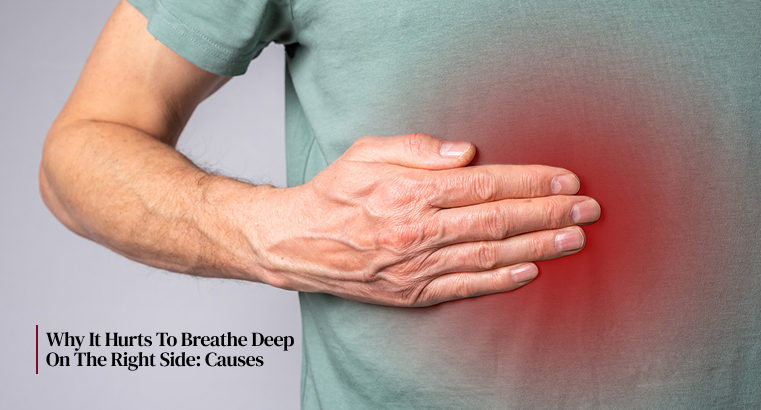
So, if you continue to wonder, “why does it hurt when I take a deep breath on my right side,” you are describing a symptom that doctors call pleuritic chest pain. This is generally the pain that worsens with breathing, coughing, or sneezing.
Most of the time, the cause is a strained muscle or an irritated rib joint. Also, in some cases, however, it originates in the lungs, liver, or gallbladder, and a few causes require treatment on the day of diagnosis.
Therefore, this guide will tell you why breathing causes pain, the most common causes, interpretation of clues, and when to seek assistance.
Why Breathing Makes Pain Worse
A deep breath is a whole-body movement. Your ribs move outwards, your diaphragm lowers, and your lungs expand against the lining of the chest wall.
Any structure that is irritated or inflamed along that pathway will complain if it is stretched.
This is why the same pain can be caused by very different organs, and why the location and nature of the pain is so important.
The Structures That Move When You Inhale
Several layers are involved:
- Rib bones and the cartilage joining them to the breastbone
- The muscles between the ribs
- Pleura, which is a thin, slippery double lining around the lungs
- The diaphragm
The liver and gallbladder are located just below the right lung and therefore can cause pain when breathing in. All of these nerves overlap, making it difficult to determine where the pain is coming from.
Why The Pain Feels Sharp
Inflammation of the pleura causes the two layers to no longer slide over each other and rub together with each breath. Moreover, this causes a stabbing pain that prevents complete breathing.
Individuals tend to begin shallow breathing to prevent it. This is normal, but can cause a buildup of mucus and lung infection if it persists for days.
The Most Common Causes Behind The Question “Why Does It Hurt When I Take A Deep Breath On My Right Side?”
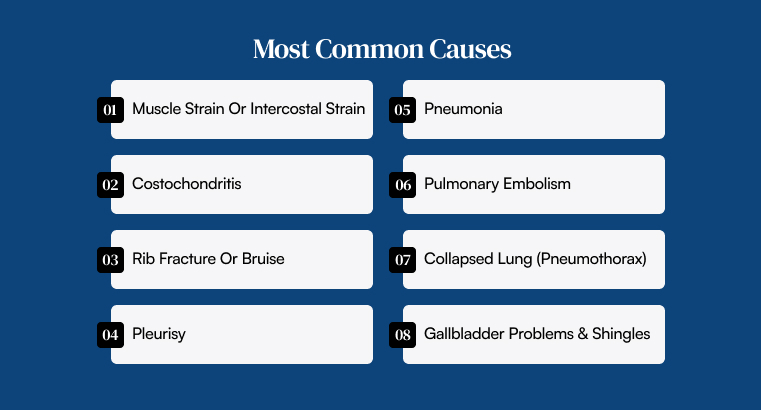
There are a handful of families of causes, from benign to urgent. First, let’s take a quick look at the table that provides an overview.
Let’s take a quick look at the table that provides an overview before we look at each in detail.
| Cause | What The Pain Is Like | Other Clues | Urgency |
| Muscle strain or intercostal strain | Sharp or aching, tender to touch, worse with twisting | Recent coughing, lifting, or exercise | Low |
| Costochondritis | Sharp, localized near the breastbone or rib edge | Tender spot reproduces the pain | Low |
| Rib fracture or bruise | Sharp, worse with any movement | Recent fall or blow | Moderate to high |
| Pleurisy | Stabbing pain with each breath, eases when you hold your breath | Often follows a viral infection | Moderate |
| Pneumonia | Sharp pain with a cough | Fever, chills, phlegm | Moderate to high |
| Pulmonary embolism | Sudden sharp pain | Shortness of breath, fast heartbeat, leg swelling | Emergency |
| Collapsed lung (pneumothorax) | Sudden sharp pain on one side | Breathlessness, often in tall, thin people or smokers | Emergency |
| Gallbladder problems | Upper right abdomen pain spreading to the shoulder | Nausea, worse after fatty meals | Moderate to high |
| Shingles | Burning band on one side | Rash or blisters after a few days | Moderate |
Muscle Strain And Rib Joint Problems
These are by far the most common causes in otherwise healthy people. A strained intercostal muscle may occur after a coughing fit, heavy lifting, a new exercise, or even after an uncomfortable sleeping position.
A sharp pain is also caused by inflammation of the cartilage at the rib/breastbone junction, known as costochondritis. One of the important clues is that pressing on the sore area, or twisting and stretching the torso, causes the same pain.
Typically, these problems resolve within 1-3 weeks.
Pleurisy And Lung Infection
Pleurisy is the inflammation of the lining of the lungs, which is most commonly caused by a viral infection, but can also be caused by bacterial pneumonia. The pain is sudden, most intense at the beginning of a breath, and may be relieved by breath-holding or pressure.
On the other hand, pneumonia adds fever, chills, a productive cough, and fatigue. This family of causes is more likely if a respiratory infection has recently swept through your home.
Blood Clots And A Collapsed Lung
These are less frequent but not to be overlooked. A pulmonary embolism is a blood clot that blocks a pulmonary artery. As a result, this leads to a sudden onset of pain, breathlessness, rapid heart rate, and sometimes coughing up blood.
Risk factors include:
- Recent surgery
- Long travel
- Pregnancy
- Hormone therapy
- Cancer
- A previous clot
Before everything, let’s understand what a pneumothorax is.
So, a pneumothorax is when air gets into the chest, and the lung partially collapses, causing sudden pain and difficulty breathing on one side. Both require emergency treatment.
Gallbladder, Liver, And Other Organs Under The Right Lung
The gallbladder and liver are located directly under the right lung, so problems with them can be mistaken for breathing issues.
The pain from gallbladder inflammation is usually in the upper right quadrant of the abdomen and increases with deep breathing. Moreover, this can radiate to the right shoulder blade, which may be associated with nausea after eating fatty foods.
Right-sided pain on inhalation can also be caused by inflammation of the liver, a kidney stone, or an infection under the diaphragm.
Shingles
The varicella-zoster virus can reactivate along a single nerve, which wraps around one side of the chest. Pain, burning, or tingling can start two to four days before any rash appears, so early shingles is easily mistaken for a lung or rib problem.
If a band of blisters follows on the right side, that settles the question. Antiviral medicine works best when started within 72 hours of the rash.
Reading The Clues: Where And How It Hurts
The site and nature of the pain further constrains the options. None of these features alone make a diagnosis. However, they can help you determine whether you should be concerned or not, and what to tell your doctor.
| Feature | Points toward |
| Tender to touch, reproduced by pressing or twisting | Muscle or rib cartilage |
| Pain after a fall, hit, or intense coughing | Bruised or broken rib |
| Fever, chills, and a cough with phlegm | Pneumonia or pleurisy |
| Sudden onset with shortness of breath | Pulmonary embolism or collapsed lung |
| Upper right abdomen, spreading to the shoulder blade | Gallbladder or liver |
| Burning, with a rash or blisters later | Shingles |
| Eased by leaning forward or by shallow breathing | Pleural irritation |
| Worse after fatty meals | Gallbladder |
Is The Location Of The Pain Significant?
In full actuality, the answer is somewhat.
So the thing is, pain high in the chest, near the collarbone or armpit, points toward the muscles, ribs, or lung. On the other hand, low pain under the right ribs is towards the liver and gallbladder.
Moreover, the pain in the back of the chest, close to the shoulder blade, may be due to the lung, a spinal joint, or referred gallbladder pain.
However, the pain may radiate, so use location as a guide.
The Timing Question
The timing here is quite significant, so always try keeping track of that.
Notice the following, where if the pain:
- Started over several days with a cold, it is likely that it is caused by pleurisy or a muscle strain
- Comes on in seconds, particularly if accompanied by difficulty breathing, it is more concerning
- Is recurring after eating, it indicates gallbladder.
So, by noting when it started and what you were doing, you tend to do one of the most useful things you can tell a doctor.
How Doctors Find The Cause
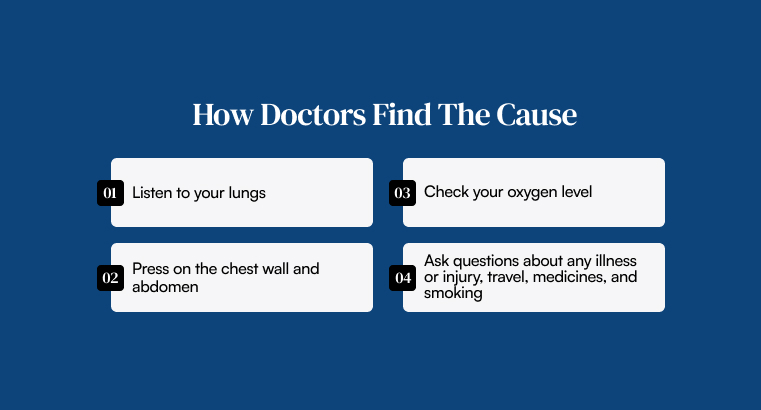
The causes are so varied that a careful history and exam is the first step.
A doctor will do the following:
- Listen to your lungs
- Press on the chest wall and abdomen
- Check your oxygen level
- Ask questions about any illness or injury, travel, medicines, and smoking
In this way, doctors select tests according to what is likely.
Common Tests
A chest X-ray may reveal pneumonia, fluid, a collapsed lung, or a rib fracture. Doctors use an ECG to examine the heart, as heart problems can also cause chest pain.
Doctors use blood tests to check for infection and inflammation, and they can use a D-dimer test to rule out a blood clot.
A CT scan of the lung arteries provides a clear diagnosis if there is a suspicion of a clot. The first test done for gallbladder problems is an abdominal ultrasound.
What The Results Mean For Treatment
Rest and pain relief treat muscle and rib pain. Pneumonia needs antibiotics, and a pulmonary embolism needs blood thinners.
A collapsed lung may need observation or a chest tube, and gallbladder problems may require surgery.
In short, treatment depends entirely on the cause, which is why guessing at home is risky when the pain is severe.
What You Can Do At Home For Mild Pain
If the pain is mild, follows an obvious strain, and has no warning signs, home care is reasonable.
The goal is to ease the pain without letting your breathing become shallow, because shallow breathing can cause mucus to build up in the lungs.
Helpful Steps
| Step | How To Do It / Key Details |
| Use heat or a cold pack | Apply to the sore area for 15 to 20 minutes at a time. |
| Take an over-the-counter pain reliever | Use acetaminophen or ibuprofen if safe for you (avoid with kidney disease, stomach ulcers, or blood thinners). |
| Hug a pillow against the area | Use it when coughing or sneezing to splint the muscles. |
| Take slow, deep breaths | Do this every hour or so, even if uncomfortable, to keep the lungs open. |
| Change sleeping positions | Avoid lying on the painful side if it makes things worse. |
| Move gently | Light walking is better than complete rest. |
What To Avoid
Avoid wrapping the chest tightly or using a rib belt, as this will impede breathing and increase the risk of pneumonia. Do not lift heavy objects or do strenuous twisting exercises until the pain has subsided.
If the pain worsens after 2-3 days, or you think it may be a pulled muscle and you have a fever or shortness of breath, don’t ignore it.
Warning Signs That Need Urgent Care
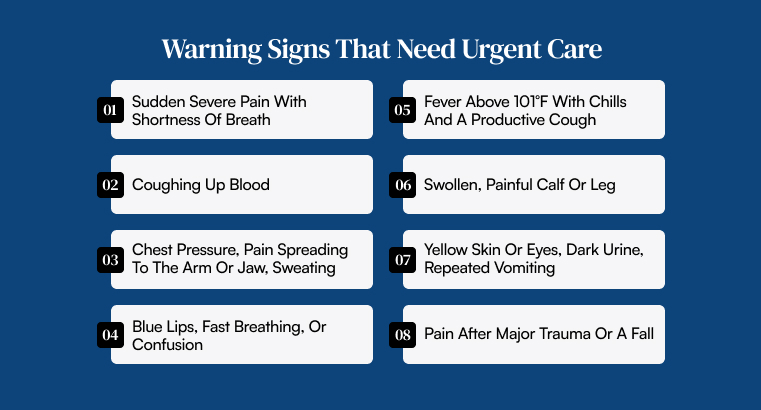
Some features turn this from a nuisance into an emergency. Know them in advance so you can act quickly.
| Warning Sign | Possible Cause | Action |
| Sudden severe pain with shortness of breath | Pulmonary embolism, pneumothorax | Call emergency services |
| Coughing up blood | Clot, infection, other serious lung disease | Emergency care |
| Chest pressure, pain spreading to the arm or jaw, sweating | Heart attack | Call emergency services |
| Blue lips, fast breathing, or confusion | Low oxygen | Emergency care |
| Fever above 101°F with chills and a productive cough | Pneumonia | See a doctor the same day |
| Swollen, painful calf or leg | Deep vein clot | Emergency care |
| Yellow skin or eyes, dark urine, repeated vomiting | Gallbladder or liver problem | Urgent care |
| Pain after major trauma or a fall | Rib fracture, collapsed lung | Emergency care |
The Right Time To Consult A Doctor: Never Ignore The Red Flags
Book an appointment if the pain lasts more than a few days, keeps returning, or limits your sleep or breathing.
See a doctor sooner if you have a fever, a persistent cough, nausea after meals, or a new rash. A smoker, someone recently immobilized, or anyone with a history of clots or heart disease should have new chest pain checked promptly.
Go to the emergency room or call emergency services for sudden severe pain, difficulty breathing, chest pressure, fainting, or coughing blood. Don’t drive yourself if you feel faint or short of breath.
So, “why does it hurt when I take a deep breath on my right side?”
Most often it is a strained muscle, an inflamed rib joint, or an irritated lung lining, and it settles within a couple of weeks.
But the same symptom can come from a clot, an infection, or the gallbladder, and the difference lies in the other clues.
But if the pain is mild and movement clearly ties to it, home care is fine. If anything about it feels sudden, severe, or unexplained, let a professional take a look.
Disclaimer: The information provided in this article is for general informational purposes only. It does not, and is not intended to, constitute medical or health advice. Please consult a qualified healthcare professional for medical guidance or expert health assistance.
References
- Sattar, S. B. A., Nguyen, A. D., & Sharma, S. (2024, February 26). Bacterial Pneumonia. Ncbibooks; StatPearls Publishing.
- Crosta, P. (2020, August 19). What to know about pleurisy. Medicalnewstoday.Com; Medical News Today.
- Pleurisy. (2025). Uofmhealth.Org. University of Michigan Health.
- Giblin, R. (2026, September 28). Chest pain. British Heart Foundation.
- Fromson, N. (2023, February 16). When chest pain isn’t a heart attack. Michiganmedicine.Org; Michigan Medicine.
What is your reaction?