By
When you explore options for non-surgical intimate rejuvenation, it is completely natural to look for visual proof.
Medical clinic galleries and online forums are filled with transformation images promising dramatic results.
However, while these photos can be helpful tools, they often present a simplified version of a complex medical procedure.
So, when you are searching “hyaluronic acid girth enhancement before and after,” you are likely looking for proof of what this procedure can actually achieve.
However, it is vital to remember that a static photo only tells part of the story.
Before-and-after photos offer a static snapshot of a dynamic process.
Lighting, camera angles, and the exact timing of the photograph play massive roles in what you actually see on your screen.
To make an informed decision, you need to understand what happens behind the lens and look past the initial visual impact.
The Quick Answer: What Do The Photos Actually Reveal
At a glance, a standard “after” photo demonstrates a noticeable increase in the overall circumference and thickness of the area.
However, what these photos are actually showing you depends entirely on when they are taken.
Most medical portfolios showcase two very different types of images.
The first category includes immediate post-procedure photos, which are taken just minutes after the injections.
The second category features settled results, which are captured several weeks or months down the line.
Crucially, standard clinical galleries almost exclusively document flaccid results.
Because hyaluronic acid (HA) fillers are soft, gel-like substances injected just beneath the skin, they alter the resting state of the tissue much more noticeably than they alter the firm state during an erection.
A photo cannot easily convey the texture, firmness, or dynamic movement of the settled filler.
The Science Behind The Screen: What Is The Role Of Hyaluronic Acid

In order to truly understand what a before-and-after photo represents, it helps to understand what the injected material is actually doing beneath the skin.
HA is not a drug, hormone, or a permanent implant. Instead, it is a temporary and biocompatible volumizer.
When used for girth enhancement, HA performs three distinct structural roles.
Physical Space Occupation
HA is a thick and sterile gel. The practitioner injects this gel directly into the subdermal layer, which is the safe zone just beneath the skin.
However, it is completely above the internal erectile chambers.
By physically placing 10ml to 20ml of this gel uniformly around the shaft, it pushes the skin outward. This immediately expands the physical circumference.
Hydrophilic Water Binding
Hyaluronic acid molecules act like tiny molecular sponges.
They are incredibly hydrophilic. This means they naturally attract and bind to water molecules from your own body.
Once injected, the filler absorbs local moisture. Consequently, this helps “plump” the tissue, smooth out skin folds, and lock the volume into place.
Biocompatible Integration
Because HA is a substance your body already produces naturally in your skin and joints, your immune system accepts it without rejection.
Over a few weeks, the gel integrates with your natural tissues.
It softens to mimic the natural feel of the body, ensuring that the resting state feels natural rather than rigid or artificial.
Three Things “Before And After” Pictures
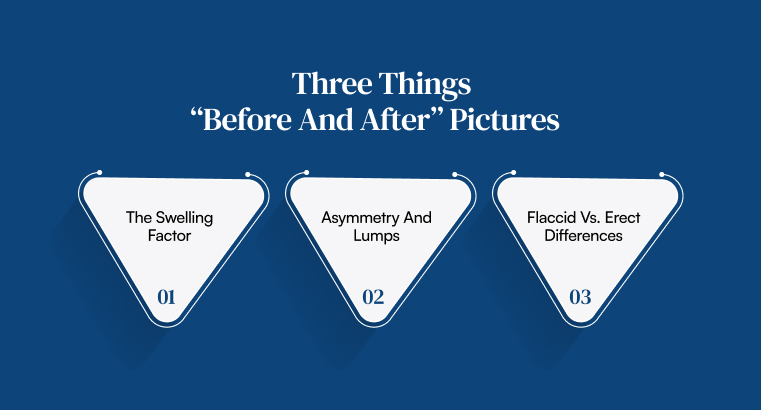
If you rely solely on internet galleries, you are missing critical context about how the human body reacts to injectable treatments.
A static image simply cannot communicate these three major hidden variables.
The Swelling Factor
HA excels at attracting water and the injection process causes minor trauma to delicate tissues. As a result, the body responds with rapid, temporary inflammation.
The “after” picture taken during the first one to fourteen days captures a significant amount of temporary edema, which is swelling.
This gives the illusion of massive volume. Once the inflammation subsides, the overall size will slightly decrease to its true, settled baseline.
Asymmetry And Lumps
The human body does not heal symmetrically.
In the days following an HA injection, the product can appear uneven. Patients incredibly commonly experience minor lumps, firmness, or localized swelling on one side.
Practitioners frequently have to perform manual molding or massage sessions during follow-up appointments to smooth out the gel.
An online gallery will rarely feature these awkward, mid-healing stages. Moreover, it skips straight from the clean baseline to the polished final outcome.
Flaccid Vs. Erect Differences
Because HA fillers rest in the superficial layers of tissue, they add bulk that is highly visible when the tissue relaxes.
However, when an erection occurs, the internal erectile chambers expand and push against the filler layer.
Moreover, the girth increases by a significantly lower percentage when erect than when flaccid.
A photo showing a massive flaccid transformation can lead to unrealistic expectations regarding how the enhancement translates during sexual activity.
Real Expectations: Immediate Vs. Settled Results
In order to help distinguish between temporary side effects and your permanent reality, the timeline below breaks down what a photo shows compared to what actually happens to the filler beneath the skin.
| Phase / Timeline | What the “After” Photo Shows | The Medical Reality |
| Days 1–7 (Immediate) | Maximum girth increase; exceptionally firm and full appearance. | High levels of temporary swelling, fluid retention, minor bruising, and localized asymmetry. |
| Weeks 2–4 (Settling) | A smoother appearance, though volume may look slightly reduced. | The acute swelling is subsiding. The HA gel is beginning to integrate with the tissue and absorb body water. |
| Months 3–6 (Maintenance) | A stable, uniform, and completely natural-looking girth enhancement. | The final, realistic baseline. The product has softened completely, and any initial lumps have resolved. |
| Months 12–18 (Long-term) | A gradual, slow return toward the original “before” baseline. | The body’s natural enzymes (hyaluronidase) are safely breaking down the filler. Maintenance touch-ups are required. |
What Is A Clinically Realistic Girth Increase?
When you analyze the before-and-after images, it will help to ground your expectations in real data. Moreover, the volume of injected product and your baseline anatomy heavily dictate the final outcome.
A standard procedure usually uses anywhere from 10ml to 20ml or more of a dense, cross-linked hyaluronic acid filler. On average, a safe and well-executed procedure yields a realistic increase of 0.5 to 1 inch in flaccid girth.
Your individual skin elasticity plays a massive role here.
Patients with tighter and firmer skin structures may experience a more subtle distribution of the gel. On the other hand, those with looser skin may see a more pronounced visual change.
Trying to push past these anatomical limits to achieve the dramatic results seen in outlier photos can lead to skin compromise or an unnatural appearance.
The Choice Beyond Injections: HA Filler Vs. Permanent Surgery
When you are exploring options for intimate rejuvenation, it would help to understand how temporary hyaluronic acid (HA) filler stacks up against permanent, invasive surgical alternatives.
Men considering these procedures must weigh the immediate convenience of non-surgical injectables against the lifelong commitment. They also need to understand the potential risks that come with going under the knife.
The choice between a temporary liquid enhancement and a permanent surgical structural change comes down to your personal budget, downtime tolerance, and aesthetic goals.
Comparing Temporary Fillers And Surgical Procedures
Below, the table provides a direct comparison between dermal hyaluronic acid filler injections and traditional surgical methods. This includes dermal fat grafting or suspensory ligament release.
| Feature / Metric | Hyaluronic Acid (HA) Filler | Permanent Surgical Enhancement |
| Primary Method | Subdermal micro-injections of soft gel. | Surgical tissue grafts or ligament severing. |
| Procedure Time | 30 to 45 minutes in an outpatient clinic. | 1 to 3 hours under general anesthesia. |
| Downtime & Recovery | 2 to 4 days; minimal physical restriction. | 4 to 6 weeks; strictly no physical exertion. |
| Longevity of Results | Temporary (lasts 12 to 18 months). | Permanent (lifetime structural alteration). |
| Reversibility | Fully reversible via hyaluronidase enzyme. | Highly difficult or impossible to reverse. |
| Texture & Feel | Soft, natural, and integrates into skin. | Risk of rigidity, scarring, or hard fat lumps. |
| Average Initial Cost | Lower upfront cost per session. | High upfront cost including surgical fees. |
Managing Recovery Timeline: What The Images Don’t Show
Before-and-after photographs elegantly display the final, polished outcome of a well-executed procedure. However, they completely skip the nuanced physiological healing stages that happen in between. Patients often expect a linear path to their final look, but the body heals in distinct waves.
Thus, knowing what to expect day-to-day helps prevent unnecessary anxiety during the recovery phase.
| Constraint Type | Timeframe | Medical Purpose |
| Sexual Abstinence | 7 to 14 days | Prevents the injected gel from shifting out of place. |
| Exercise Limitations | 5 to 7 days | Keeps blood pressure stable and minimizes swelling. |
| Temperature Avoidance | First 7 days | Avoids worsening local inflammation from excessive heat. |
The Reality Of Post-Injection Maintenance
In contrast to permanent surgeries, HA fillers are highly dynamic. Since the gel is place superficially, practitioners frequently instruct patients to perform gentle, targeted self-massage after the initial swelling subsides.
Moreover, this manual molding ensures the product distributes evenly, while preventing the formation of small localized capsules. If minor asymmetries persist after week four, a simple touch-up or micro-dose of a dissolving enzyme can effortlessly sculpt the area into perfect symmetry. This is a flexibility that surgery just cannot offer.
Disclaimer: The information provided in this article is for general informational purposes only. It does not, and is not intended to, constitute medical or health advice. Please consult a qualified healthcare professional for medical guidance or expert health assistance.
What is your reaction?